Actual Yield Calculator
Calculate actual yield, percent yield, or theoretical yield for any reaction. Enter any two and get the third, with stoichiometry and multi-step yield tools.
https://hexacalculator.com/calculators/chemistry/analytical-chemistry/actual-yield-calculator
Chemistry
Analytical Chemistry
Actual Yield Calculator
Calculate actual yield, percent yield, or theoretical yield for any reaction. Enter any two and get the third, with stoichiometry and multi-step yield tools.
Actual Yield Calculator
%
Enter any two of theoretical yield, actual yield, or percent yield, and the calculator fills in the third for you.
Find the theoretical yield from a balanced equation
Enter the limiting reactant and molar masses to estimate the theoretical (maximum) yield.
Compound this yield across a multi-step synthesis
See the overall yield when the same per-step yield repeats over several steps.
Please input values into the fields
Was this calculator helpful?
It takes one click and shapes what we fix next.
Add as preferred on GoogleShow the recovered-vs-lost breakdown
A pie of how the theoretical yield splits into product recovered and material lost.
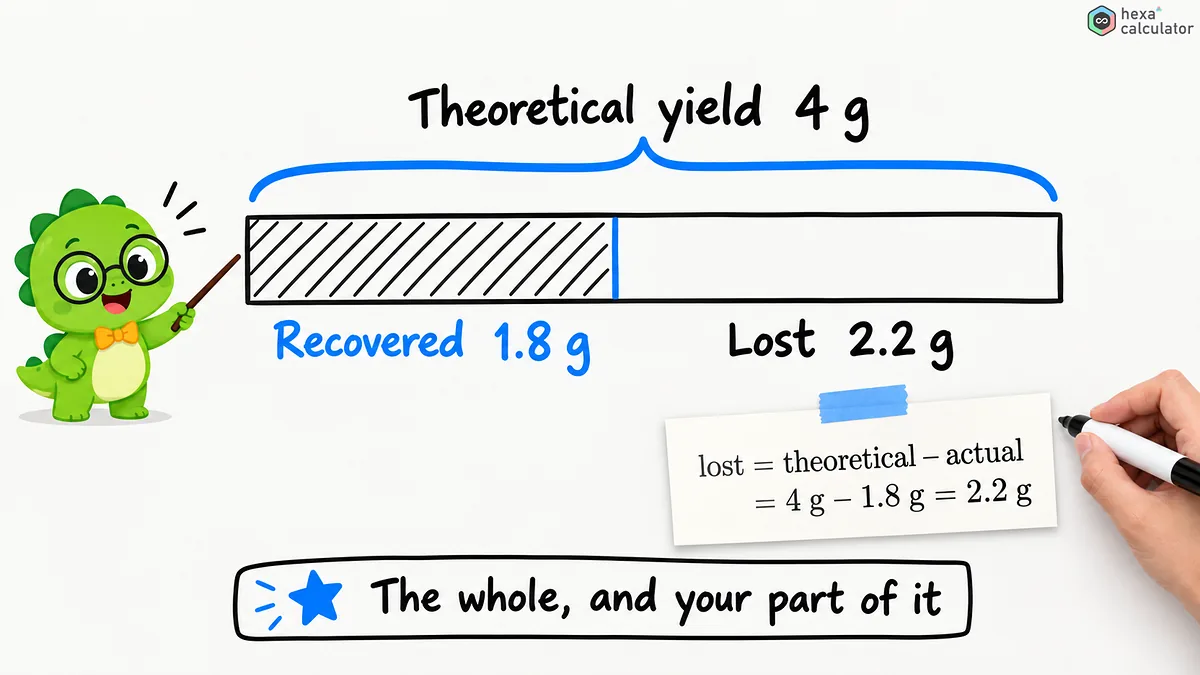
There are few reactions where the calculated total amount of product is obtained according to stoichiometry. Side reactions consume substances while transferring substances remain on glassware and also small amounts of product are lost in the final filtrate solution. This tool for calculating actual yield combines three values; theoretical yield, actual yield and yield (%). If two out of these three values are entered, then the third value can be calculated. By opening the stoichiometry panel you can calculate the theoretical yield from a balanced chemical reaction equation. By opening the multi-step reaction panel you can see how the yields accumulate at each step during the entire synthesis.
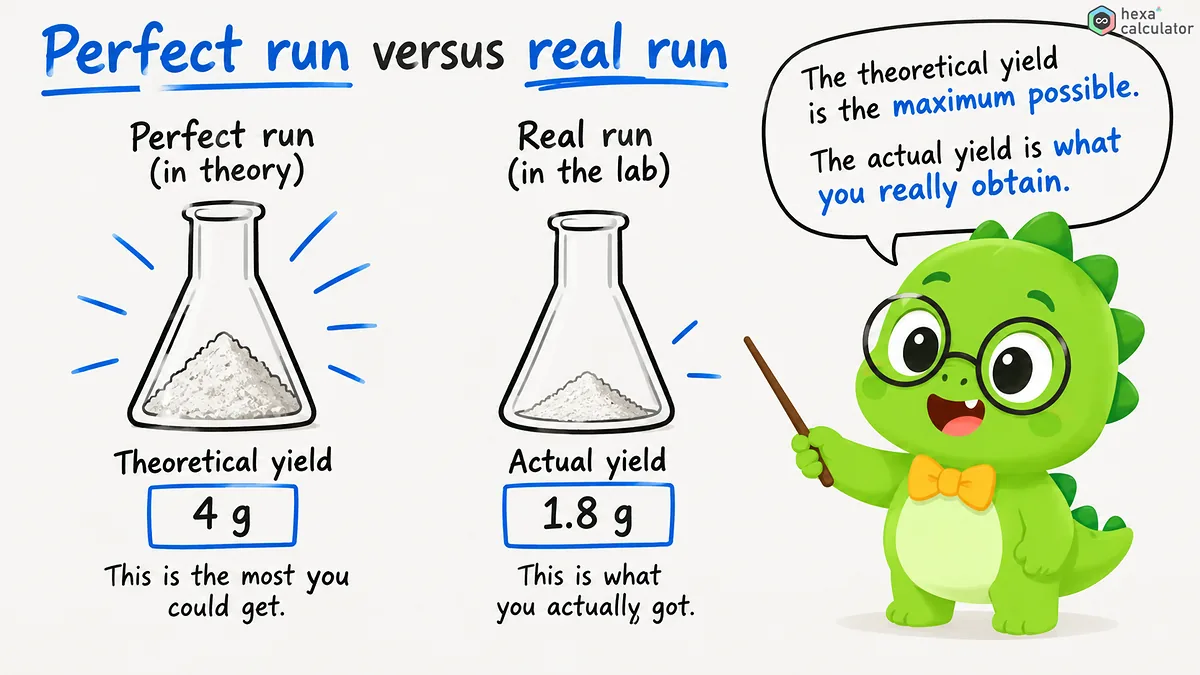
Actual yield and theoretical yield
The actual yield is the mass of a pure product obtained after completion of the reaction and measured with a balance. The theoretical yield is an achievable maximum value. It refers to the amount of product that would be theoretically obtained if all molecules of the limiting reactant were completely converted, and the entire product could be recovered. The percent yield is the ratio of actual yield to theoretical yield, i.e., the fraction of the actual quantity obtained relative to the theoretical maximum quantity. The difference between actual and theoretical yields provides insight not only into the state of the reaction itself but also into the skillfulness of the experimental procedure.
How to use this calculator:
If two of the three fields are filled in, the third is calculated immediately. If you calculate the theoretical yield from a balanced chemical reaction equation and measure the actual yield with a scale, then this tool will calculate the yield (in percent). Even if you have not performed the reaction yet, you can calculate the expected actual yield by simply entering the theoretical yield and target yield (in percent). To restart the calculation, clear one of the fields and enter a new value. In the mass field, you can specify grams, milligrams or other units that are actually shown on the scale.
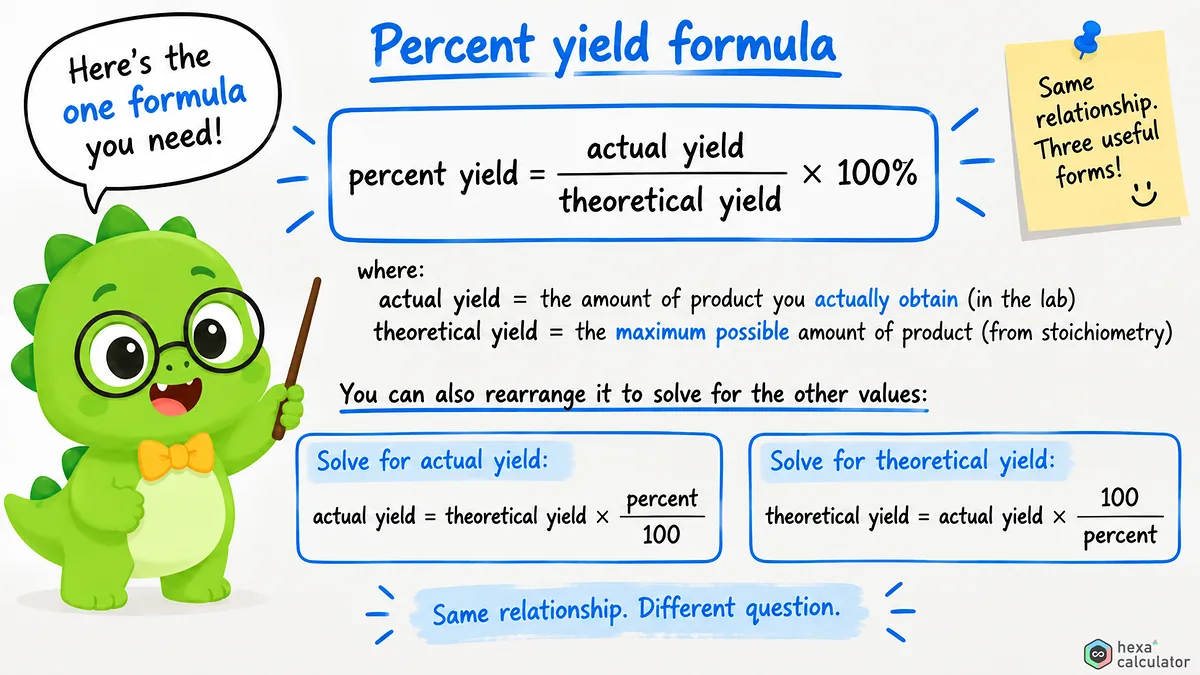
Formula for yield (as a percentage):
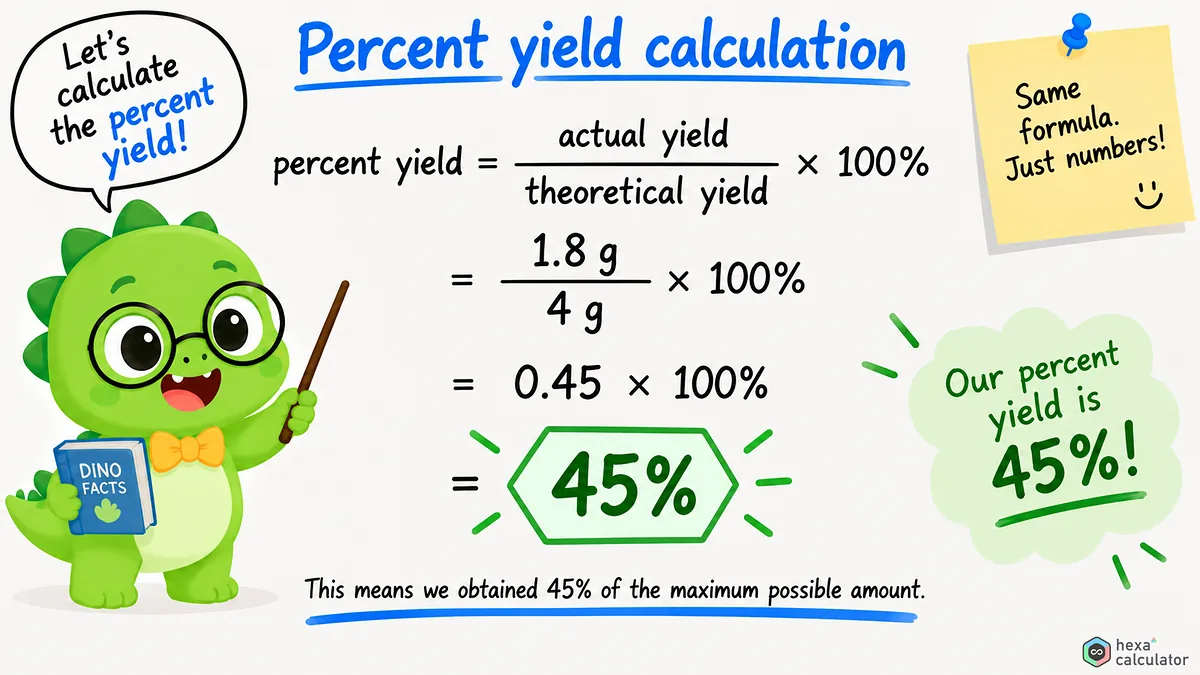
To calculate the percent yield, divide the actual yield by the theoretical yield and multiply the result by 100.
By rearranging the same relationship, the other two quantities can also be determined. The calculator uses this method to fill in the blank fields.
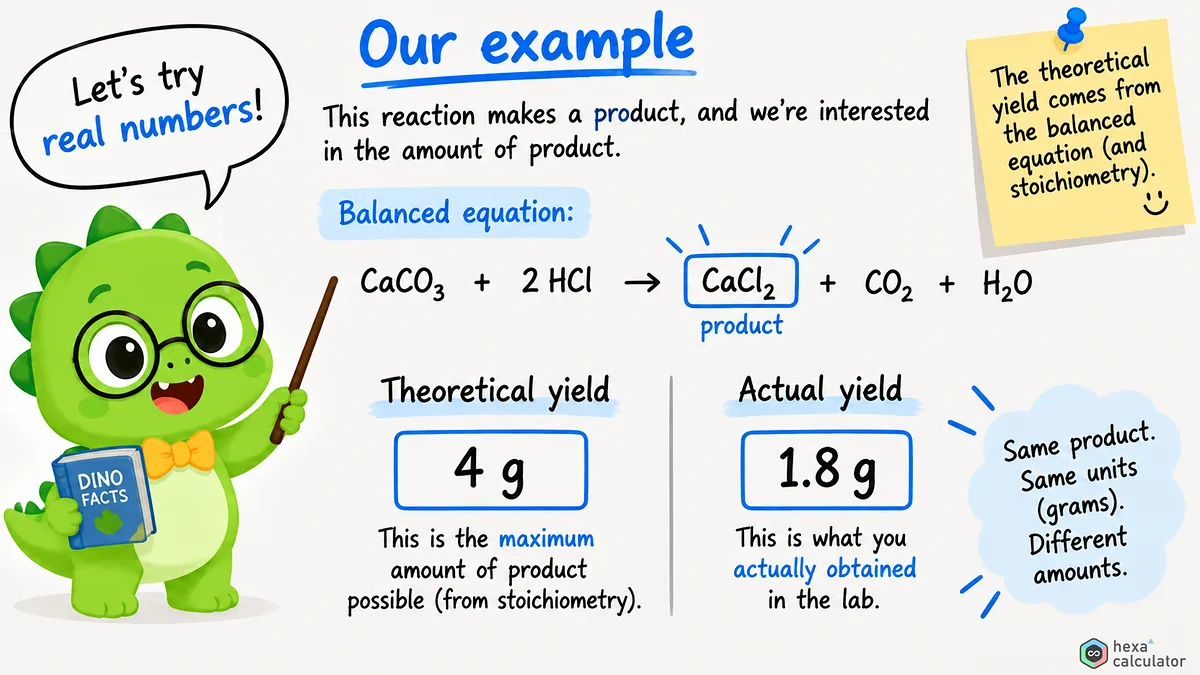
Suppose the theoretical yield of a reaction is 4 grams and only 1.8 grams of pure product could be isolated at the end. If we divide 1.8 by 4, we get 0.45, and multiply this by 100.
The opposite is true: if the desired yield is 79% and the theoretical yield is 19 grams, then the expected actual yield is the result of multiplying 0.79 by 19, which is about 15 grams.
The calculation of theoretical yield is based on stoichiometry of chemical equation.
If the theoretical yield is unknown, open up the stoichiometry panel. Use the molar masses to convert the mass of the limiting reagent into moles and then use the mole ratio between products and reactants from the chemical equation to convert it back into moles. Finally, use the molar mass of the product to convert it back into grams.
For example, when burning 5 grams of methane (with a molar mass of 16 g/mol) to carbon dioxide (with a molar mass of 44 g/mol), the molar ratio of both substances is one to one. First divide 5 by 16, which gives you 0.3125 moles. When multiplying this with 44, the theoretical yield for carbon dioxide is about 13.75 grams.
How to interpret the yield (in percent):
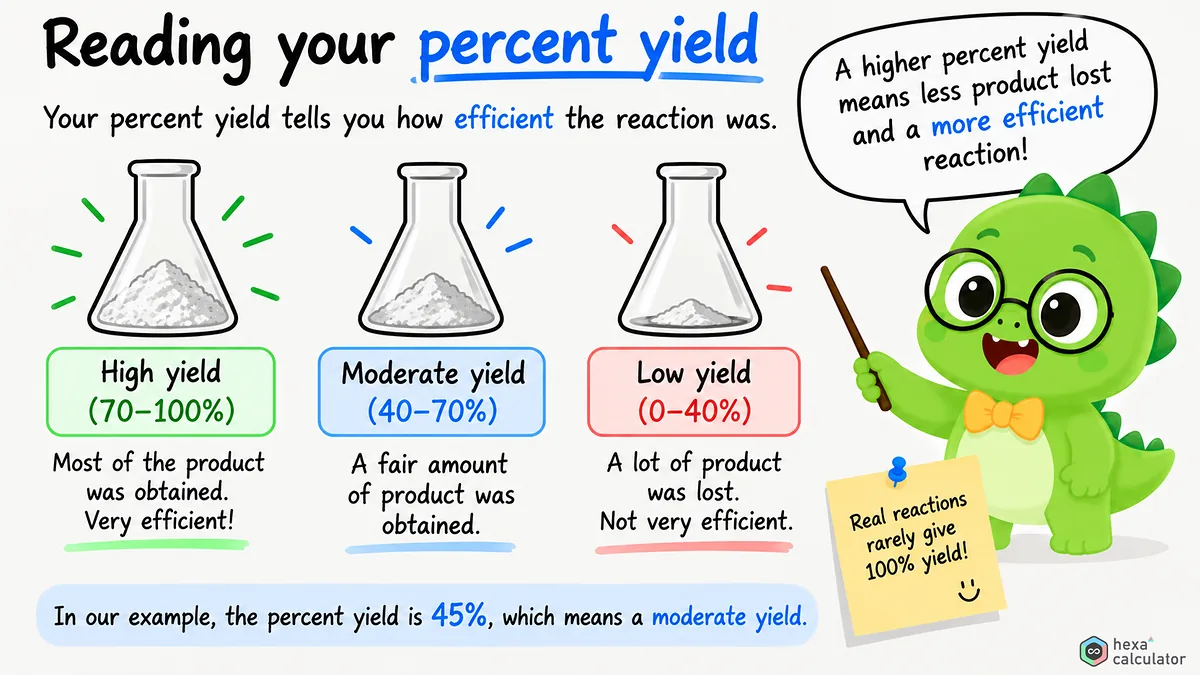
For many successful reactions the yield is usually between 50% and 90%. A value less than 100% is also normal. Sometimes substances are lost during work-up, an equilibrium reaction does not go to completion or some of the starting material is used up in side reactions. Values over 100% require more attention and generally mean that the product is contaminated with another substance. This might be a solvent which has not been evaporated off, moisture from the air or unreacted starting material which has crystallized out along with the product. The following table shows how some common results should be interpreted.
Percent yield | What it usually means |
|---|---|
90% and up | A clean, well-behaved reaction with careful workup |
70% to 90% | A solid single-step result |
50% to 70% | Workable, but losses or a sluggish reaction |
Under 50% | A difficult reaction, or material lost on transfer |
Over 100% | Impure or wet product; dry and re-weigh |
Why does overall yield decrease so much in multi-step reactions?
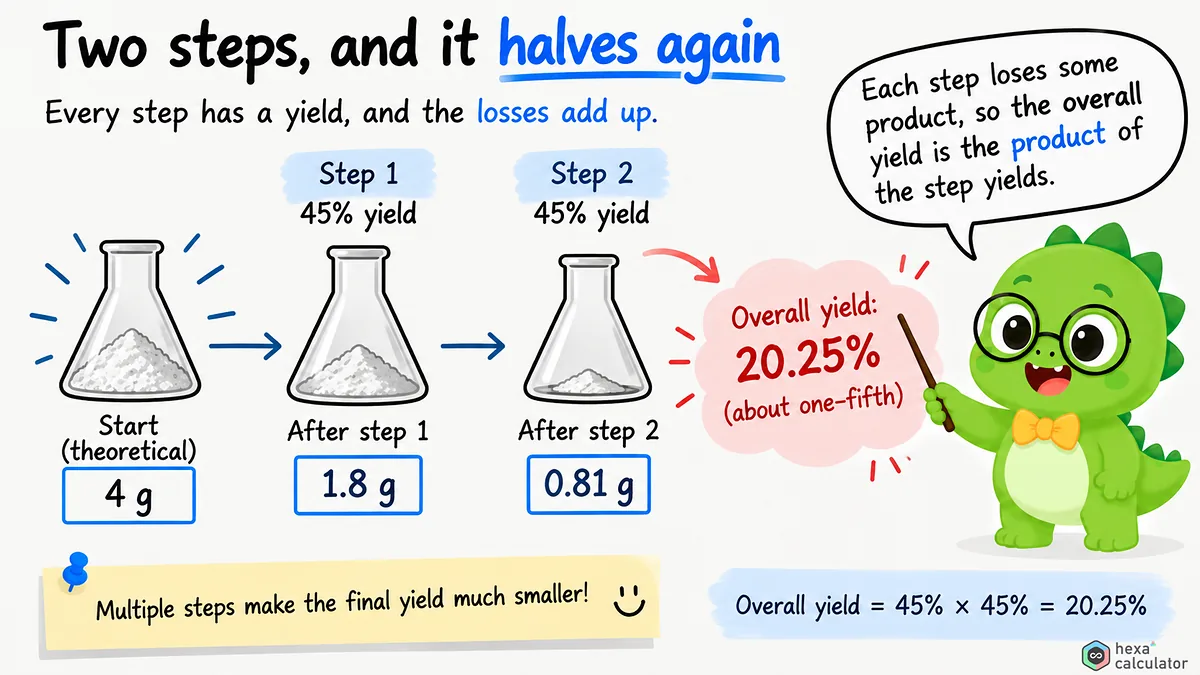
The yields of each step are multiplied together. If the yield is the same for every step in a synthesis, then the overall yield will be the product of that yield raised to the power of the number of steps. A 80% yield per step sounds good but if you do four consecutive steps, then 0.8 raised to the fourth power is about 0.41, which means your overall yield can only be about 41%. The multistep reaction panel will automatically calculate this for you.
Per-step yield | After 2 steps | After 4 steps | After 6 steps |
|---|---|---|---|
90% | 81% | 66% | 53% |
80% | 64% | 41% | 26% |
70% | 49% | 24% | 12% |
Practical tips for reliable results:
Make sure the product is completely dry before weighing. Residual solvents or moisture picked up from the air can make the yield (in percent) appear higher than it actually is. The accuracy of your balance must be calibrated to the scale of the reaction. For milligram-scale experiments, keep four decimal places and for gram-scale experiments, keep three decimal places. Check purity with NMR, IR or melting point before finalizing the value. A mixture containing impurities will not have a high yield even if the percent is high. Account for losses that may occur during transfer, filtration, and recrystallization. Even if an experiment in literature has a reported yield of 92%, another researcher might only get 70% when they first perform the procedure.
Frequently asked questions
How do you calculate yield (as a percentage)?
Divide the actual yield by the theoretical yield and multiply that number by 100. For example, if you actually got 1.8 grams but your theoretical maximum was 4 grams, then divide 1.8 by 4 and multiply by 100 to get a percent yield of 45%. This tool will automatically calculate the result for you when you enter in both the actual and theoretical yields.
Can the yield (in percent) exceed 100%?
Yes it is possible. In this case the sample is usually not as pure as expected though. Residual solvents, unreacted starting materials and absorbed moisture will increase the mass but do not contribute to the actual amount of product. If the result often exceeds 100% you should wash the sample again, extend the drying time for the product or check the molar masses used in the calculation of the theoretical yield.
What yield (in percent) is considered good?
This depends on the particular reaction pathway. For a fully optimized one-step reaction the yield is usually between 70% and 90%, and in very clean reactions it can even exceed 90%. In multi-step synthesis this has a large effect on the overall yield, where each step may have an 80% yield but if four steps are performed consecutively then this compounds to about 41%.
How is theoretical yield calculated?
The molar masses are used to convert the mass of the limiting reagent into amount of substance, then it is multiplied by the molar ratio of products to reactants in the chemical equation and finally converted back into mass using the molar mass of the product. If you open the Chemicals Calculator panel a calculation tool will perform these steps for you.
Why can actual yield be higher than theoretical?
This indicates that the mass of the sample is greater than the mass of pure substance contained within it. This is usually due to residual solvents, inadequately removed inorganic salts or co-crystallized impurities. If the yield exceeds 100%, you should re-purify the sample and dry it until constant weight before weighing again to see if the result is reliable.
Related calculators
Disclaimer: This calculator is provided for general informational and educational purposes only. Our calculators are under active development, and results may be inaccurate, incomplete, or unsuitable for your situation. Always verify the figures independently and seek advice from a qualified professional before relying on them. We make no warranties and accept no liability for any loss or decision arising from use of this tool.
References
- LibreTexts: Theoretical and Percent Yield
How theoretical, actual, and percent yield relate, with worked examples.
- Wikipedia: Yield (chemistry)
Definitions of reaction yield and why actual yield differs from theoretical.