Animal Mortality Rate Calculator
Find a herd or flock's mortality rate, survival rate, cumulative mortality, and case fatality from stock records or loss counts, with a clear outcome breakdown.
https://hexacalculator.com/calculators/daily/general/animal-mortality-rate-calculator
Daily
General
Animal Mortality Rate Calculator
Find a herd or flock's mortality rate, survival rate, cumulative mortality, and case fatality from stock records or loss counts, with a clear outcome breakdown.
Animal Mortality Rate Calculator
Add disease (case fatality) analysis
Compare how deadly a specific disease is to the animals it infects.
Plan against a target mortality rate
See how many deaths keep you at or below a rate you choose.
Enter your animal numbers and the mortality rate fills in here.
Please input values into the fields
Was this calculator helpful?
It takes one click and shapes what we fix next.
Add as preferred on GoogleShow the herd outcome breakdown
Split the herd into still alive, removed, died, and lost.
Show the mortality measures chart
Compare the mortality, cumulative, and case-fatality rates.
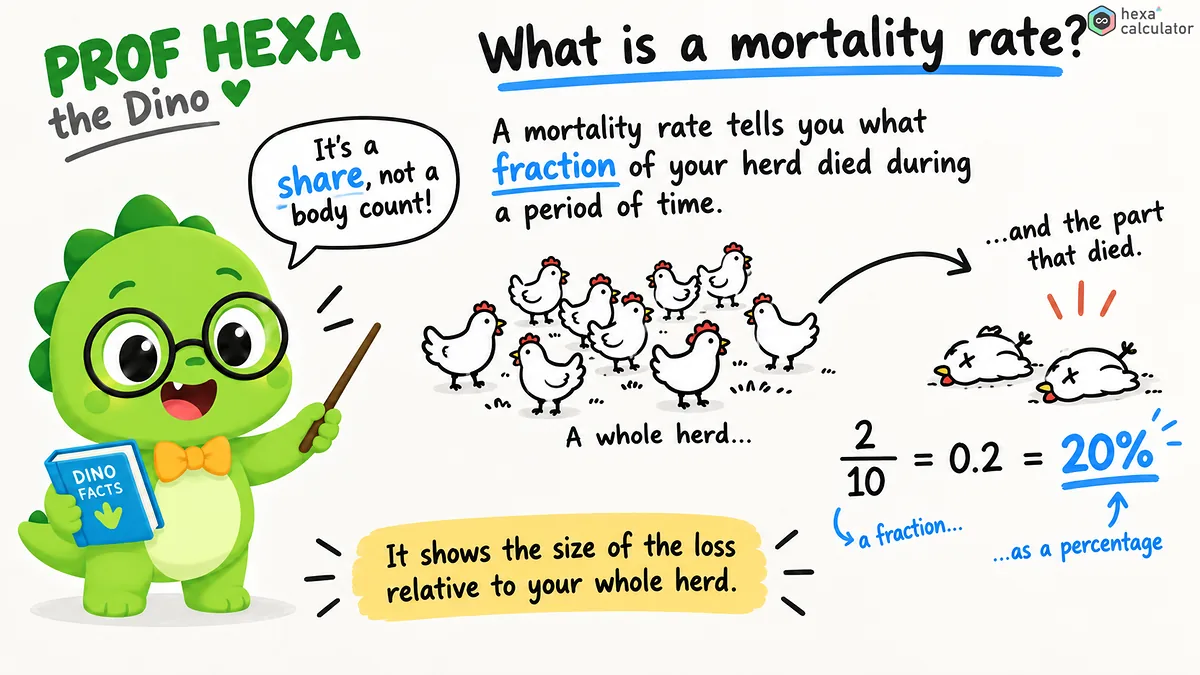
Animal mortality rate is the percentage of animals that die within a given time period in a population of livestock or poultry. It is an easily understood indicator of animal husbandry conditions as it typically shows up quickly when there are feed shortages, disease outbreaks, or adverse weather.
This calculator can be used in two ways. If you have records of the number of animals, then enter the starting and ending numbers to calculate the deaths. If you are doing a field survey, just count the current number of animals present and the number lost. Both methods will give you a breakdown of mortality rate, survival rate, and actions that should be taken based on those results.
What is animal mortality rate?
Mortality refers to the death of animals within a population, whether it is a broiler house, fish pond or dairy herd. Some loss is inevitable as numbers increase so the aim is to keep losses at a level that does not affect production. Mortality rate quantifies this risk and gives the percentage of animals that have died during the period being considered relative to the total number of animals.
This is directly related to the survival rate. The survival rate is the percentage of animals that survive. For example, if a population has a mortality rate of 7%, this can also be expressed as a survival rate of 93%.
How to use this calculator.
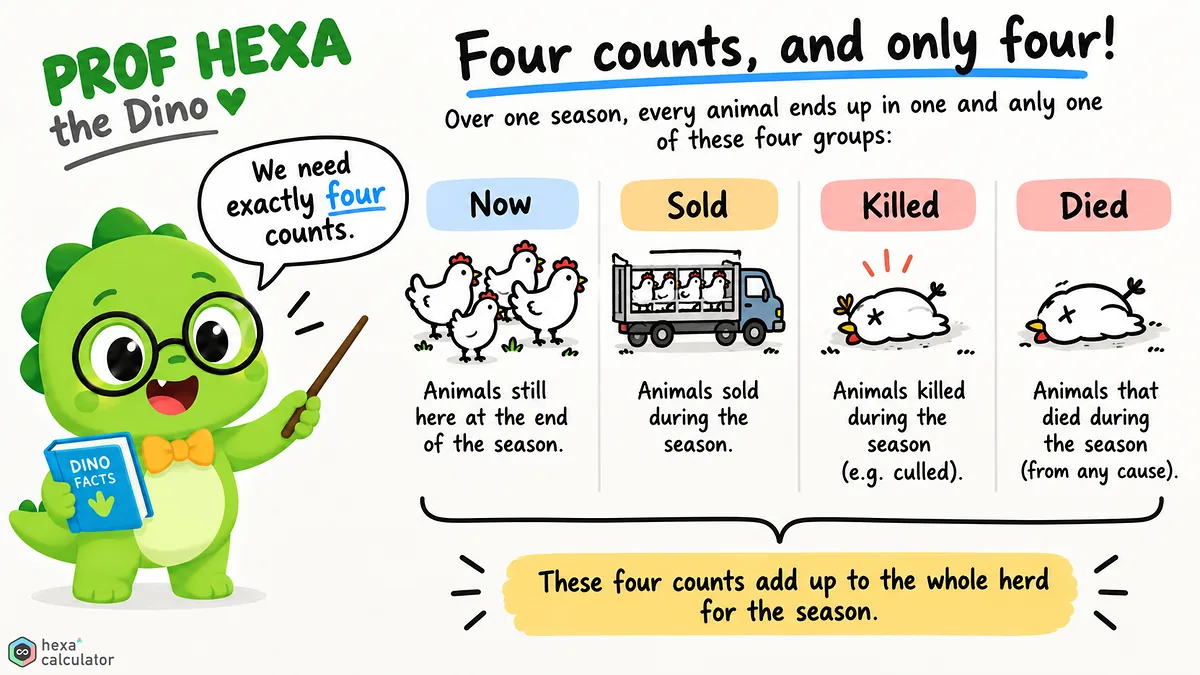
First select a method. Direct counting of losses is suitable for household surveys and quick assessments. Enter the number of animals currently held, the number sold or eaten, the number killed or stolen, and the number died from disease. The livestock population calculation is suitable for those who keep records of their animal numbers. Enter the number of animals held at the start of the period, the number born, the number sold, and the number held at the end of the period to work out deaths by subtraction.
When disease analysis is enabled, you can add the mortality rate when an infectious disease breaks out. When the target is enabled, you can set an acceptable upper limit for the number of deaths and ensure that it stays below the set mortality rate. The pie charts and metrics will be updated according to the data entered.
Understanding the formulas
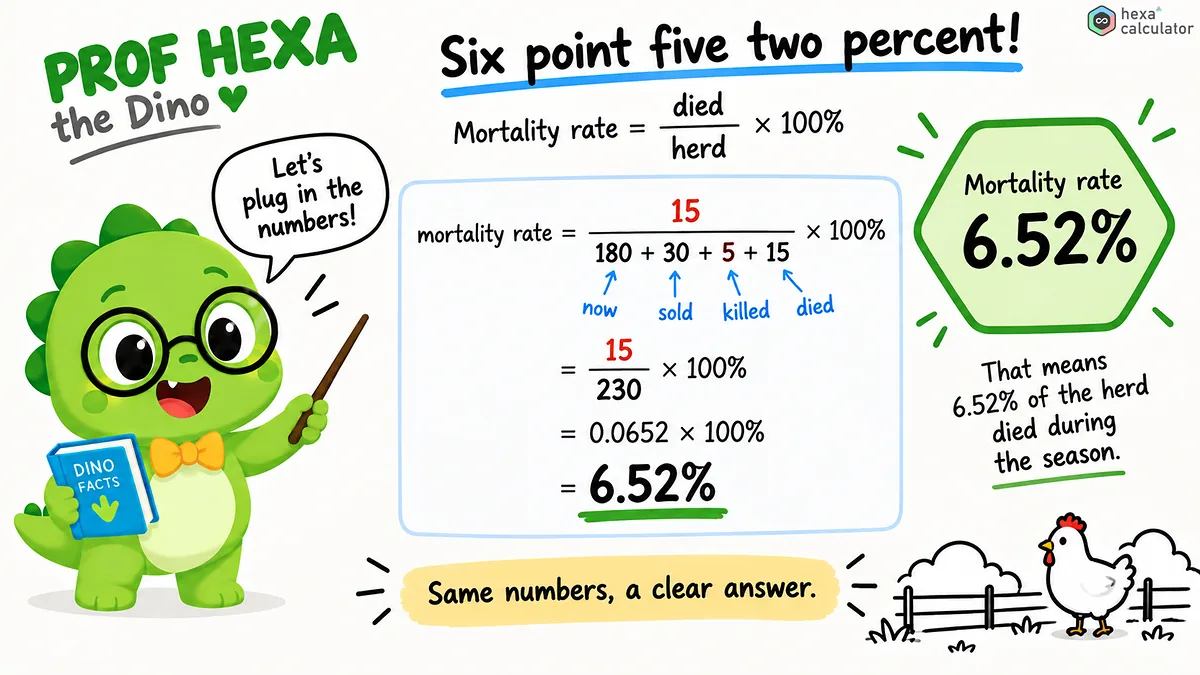
For direct counting, the mortality rate is the number of animals that died from disease divided by the total number of animals held during that time. The total includes all animals sold, eaten, given away, slaughtered, stolen or died.
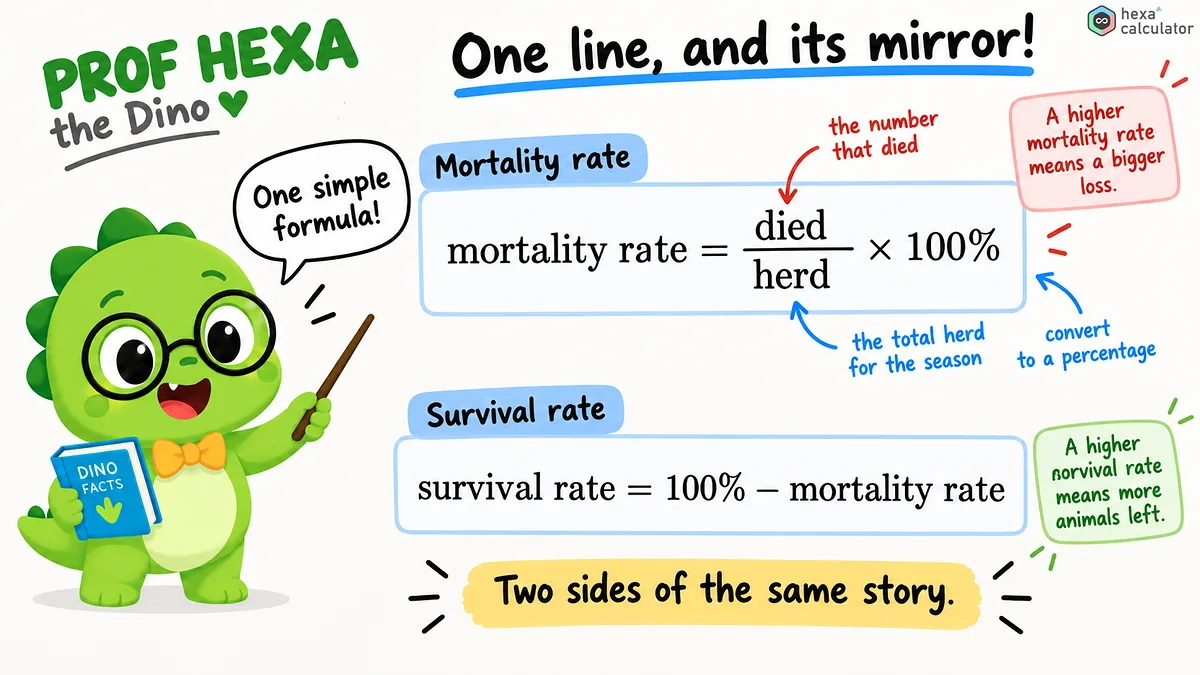
Using the livestock count method, you first determine deaths by counting how many animals should be in your herd and then divide that number by the available stock.
Let's look at an example of a field survey using IndiKit. A village has 200 chickens die during the study period and there are a total of 2,000 chickens kept in the village. This gives us a mortality rate of 10%, calculated as 200 divided by 2,000. Let's look at another example of disease. A farm has 200 pigs, 53 of which become sick and 18 die. The mortality rate is 9%, calculated as 18 divided by 200, while the case fatality ratio is 34%, calculated as 18 divided by 53. Overall this population seems to be very healthy but this disease is highly fatal for pigs that become infected with it.
Two additional metrics can provide a more comprehensive picture. The cumulative mortality rate is calculated by dividing the number of deaths by the number of animals alive at the end of the time period, while the disease-specific mortality rate divides the number of deaths from diseases by the number of reported cases of illness.
The table below shows the individual input parameters and examples:
Symbol | Meaning | Example |
|---|---|---|
Current | Animals you raise now | 180 |
Sold | Sold, eaten, or given away | 30 |
Killed | Killed by predators or stolen | 5 |
Died | Died from disease or illness | 15 |
Opening | Stock at the start of the period | 200 |
Closing | Stock alive at the end | 182 |
Rate | Mortality rate | result |
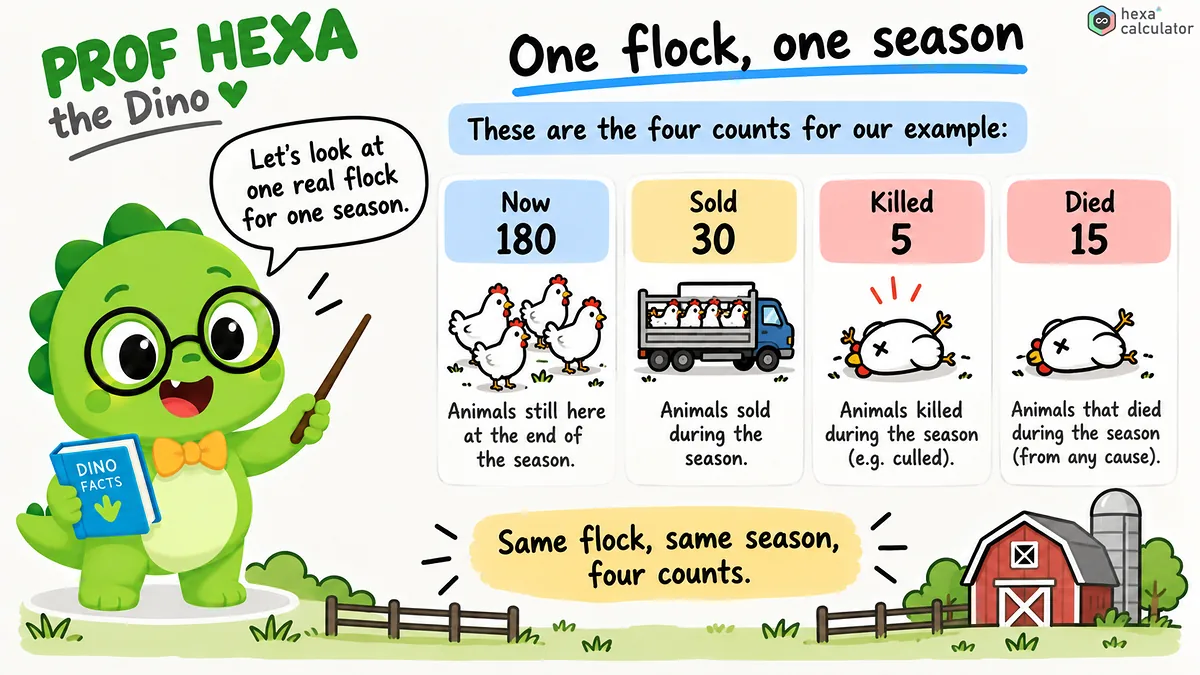
The mortality rate for the above example turns out to be 6.52%
The difference between mortality rate and case fatality rate
These two metrics answer different questions and if a farm only tracks one of them it can lead to problems. The mortality rate tells you how many animals have died out of the total population so is a measure of loss across the entire herd. The case fatality rate shows how deadly a particular disease is for those actually affected by it.
A low mortality rate with a high case fatality rate is a warning sign and not a reassuring one. This usually means that the serious disease has only affected a small number of animals so far. Whether or not it can be detected early enough to prevent its spread will determine whether there are minor losses or if the entire herd is at risk.
Factors that lead to death of animals.
The four main causes of recurring problems on a farm are: First, malnutrition. When animals are underfed they become too weak to grow properly or fight off diseases. So stable feeding and clean drinking water should be top priority. Second is age. Animals are most vulnerable in their early days and when they're old. Young animals and breeding stock need special care while older herds should usually be sold early.
Third, the environment plays a role. Overcrowded, damp or poorly ventilated barns promote disease and stress in animals. Clean, well-ventilated barns help keep animals healthy. Fourth, the disease itself is a factor and is often the cause of death on many farms. Vaccinations and basic biosecurity measures can prevent many dangerous infections.
Tips for accurate recordings:
The accuracy of mortality data depends on the underlying counts. So don't guess - record daily. It is important to take measurements within a particular time frame and compare like with like. In development projects six monthly snapshots are often used for poultry and small mammals, while cattle and pigs, where losses are lower and easier to remember, can be extended to one year.
Also consider the seasonality of deaths. Deaths often cluster in hot, cold or wet periods so compare data from the same month across years. If possible, record young and adult animals separately. The mortality rates for chicks or calves are very different to those for adult herds and mixing up the data can lead you to overlook real problems.
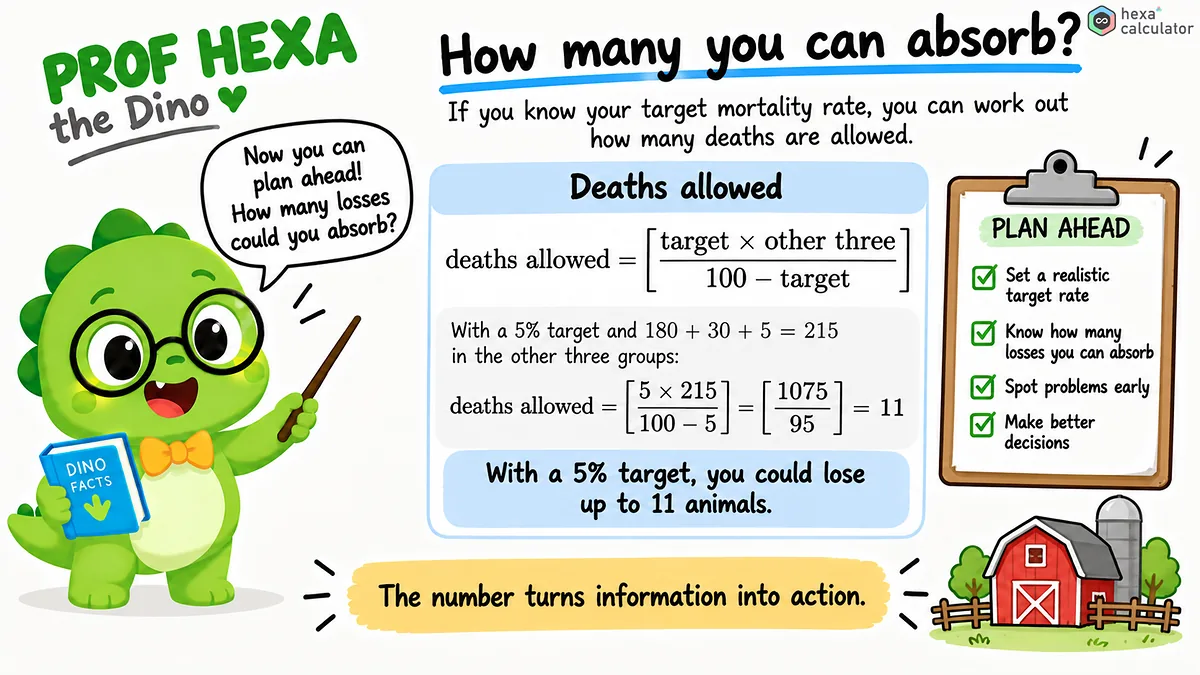
You can also use these number to plan your farm on how many deaths of animals is allowed.
Frequently asked questions
What is a normal or good death rate?
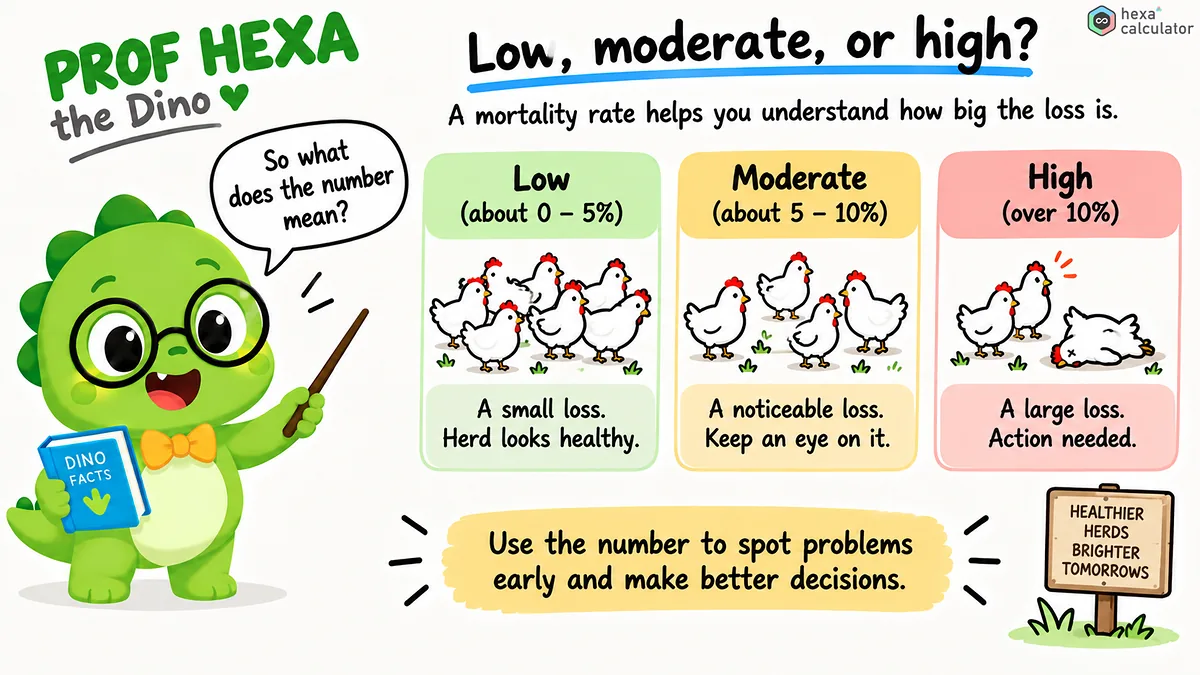
As the values vary according to species and age of animal there are no set numbers that apply in all situations. Many farms aim for a mortality rate below 5% but usually young animals have higher mortality than adults. Do not use mortality data to pursue rigid targets, rather look at trends over time.
What is the difference between mortality rate and case fatality rate?
Mortality rate refers to the total number of deaths in a herd while disease mortality rate only takes into account the number of animals that died from a particular disease. Both are important as even if the overall mortality rate is very low, a large proportion of the animals infected with a particular disease may die.
If you only know the number of animals at the beginning and end of a time period, which method should you use?
Use a herd balance method. Enter the number of animals at the beginning of the time period, the number born, the number sold and the number at the end of the time period, and the missing number is used to calculate deaths. You do not need to directly count the number of dead animals.
Over what time period should mortality be measured?
Choose a specific time period for analysis and use it consistently. Six months is appropriate for poultry or other small animals, while cattle and pigs are usually considered over one year. Compare the same periods of different years to avoid confusing seasonal fluctuations with trends.
Are animals sold or eaten counted as deaths in the calculator?
No. Animals sold, used for personal purposes or given away are considered as removals and not deaths. They will be taken into account in the total number of animals kept (the denominator), but not in the actual number of deaths.
Related calculators





Disclaimer: This calculator is provided for general informational and educational purposes only. Our calculators are under active development, and results may be inaccurate, incomplete, or unsuitable for your situation. Always verify the figures independently and seek advice from a qualified professional before relying on them. We make no warranties and accept no liability for any loss or decision arising from use of this tool.
References
- IndiKit: Animal Mortality indicator (People in Need)
Standard survey wording and calculation for the livestock mortality indicator.
- NIST Special Publication 811: Guide for the Use of the International System of Units
The US national standard for SI units, unit names and symbols, and conversion factors.