Accrued Interest Calculator
Calculate the accrued interest on a bond between coupon dates, with every day-count convention, par and coupon inputs, and the dirty (invoice) price a buyer pays.
https://hexacalculator.com/calculators/finance/bonds/accrued-interest-calculator
Finance
Bonds
Accrued Interest Calculator
Calculate the accrued interest on a bond between coupon dates, with every day-count convention, par and coupon inputs, and the dirty (invoice) price a buyer pays.
Accrued Interest Calculator
%
Frequency Options
DayCountBasis Options
Accrued Interest Calculation Options
Turn on to convert a quoted clean price into the dirty (invoice) price.
Add invoice (dirty) price
Convert a quoted clean price into the dirty (invoice) price.
Accrued interest
- Days accrued
- Days left in period
- Period elapsed
- %
- Full coupon
- $
- Accrued per 100
- Daily accrual
- $
- Days to next coupon
Settlement is 91 days into a 182-day coupon period (50% elapsed). A buyer pays 1.25 of accrued interest per 100 of par, on top of the price.
Was this calculator helpful?
It takes one click and shapes what we fix next.
Add as preferred on GoogleShow coupon schedule
Show a coupon-by-coupon schedule around the settlement date.
Period start | Period end | Days | Coupon | Status |
|---|---|---|---|---|
| Jul 1, 2023 | Jan 1, 2024 | 184 | 25 | Paid |
| Jan 1, 2024 | Jul 1, 2024 | 182 | 25 | Accruing now |
| Jul 1, 2024 | Jan 1, 2025 | 184 | 25 | Upcoming |
| Jan 1, 2025 | Jul 1, 2025 | 181 | 25 | Upcoming |
| Jul 1, 2025 | Jan 1, 2026 | 184 | 25 | Upcoming |
| Jan 1, 2026 | Jul 1, 2026 | 181 | 25 | Upcoming |
Accrued interest is the portion of a future coupon payment on bonds that has accumulated up to the settlement date. This calculator allows you to find accrued interest, accrued interest per 100 units of par value and price (settlement price) which is calculated from net price plus accrued interest by entering relevant data such as bond date, coupon rate and face value.
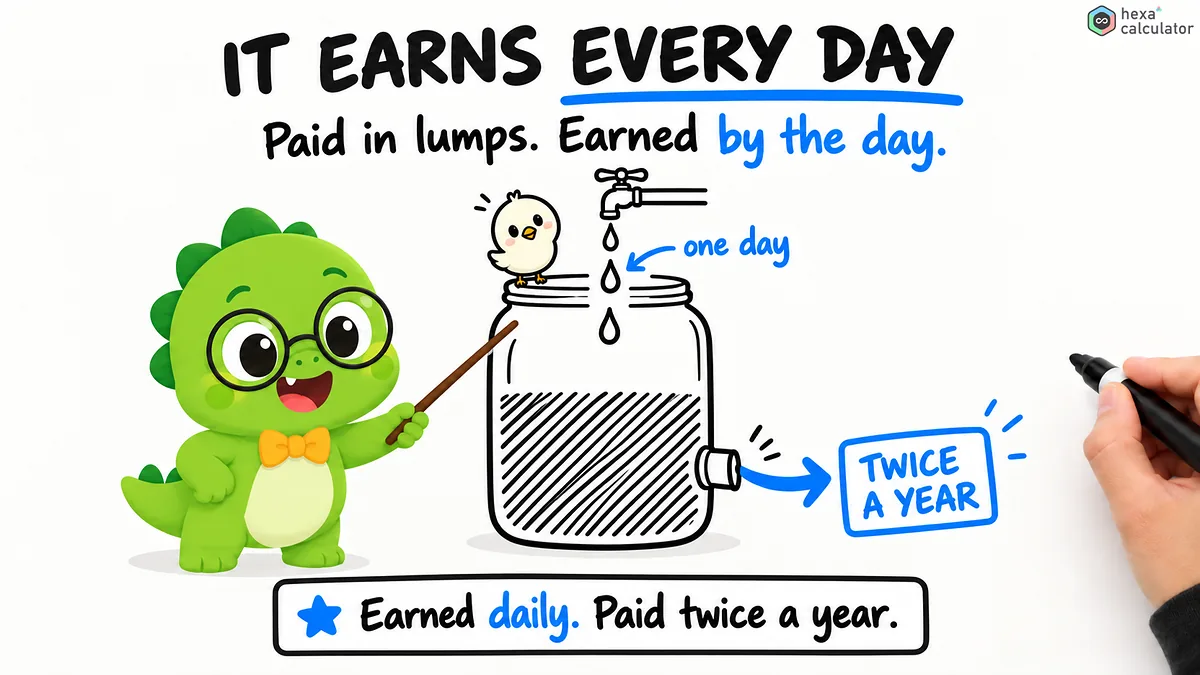
What is term of interest?
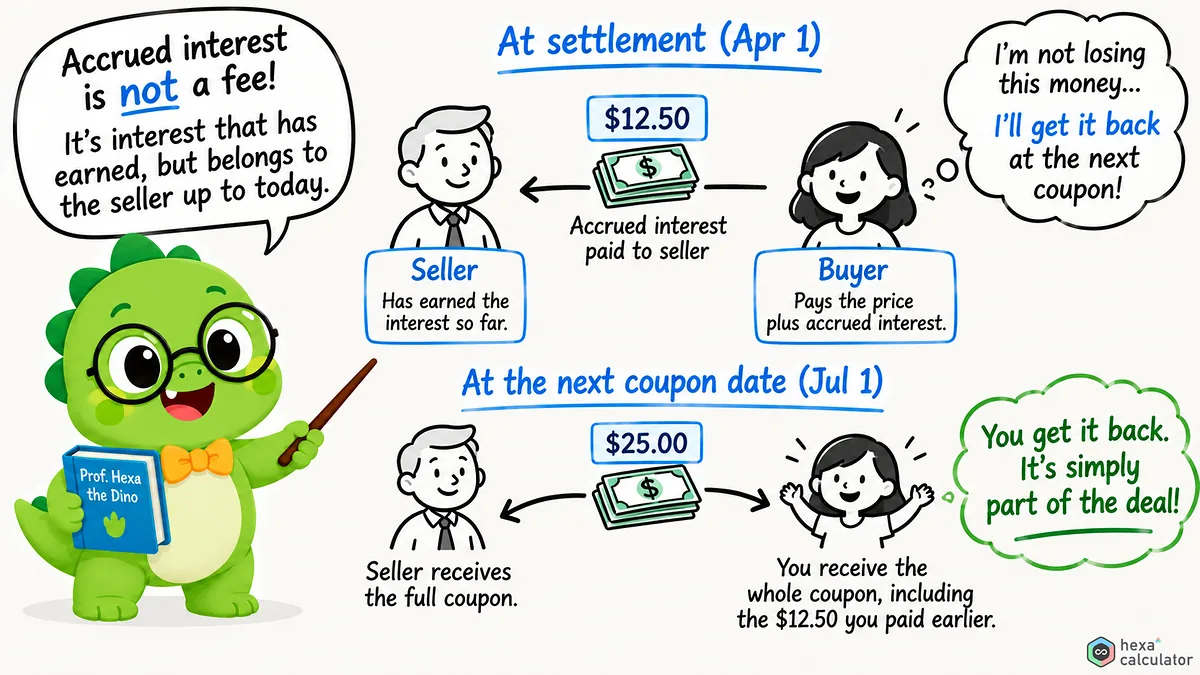
Bonds pay coupons on specific dates but also accrue interest daily between coupon payment dates. The accrued interest is the portion of the next coupon that has accumulated up to the settlement date. Since the seller held the bond for a certain period within the current interest period, the buyer must pay the seller the interest due for that period. At the next coupon payment date, the issuer pays the full amount of the coupon for that period to everyone who owns the bond at that time, thus settling the accrued interest.
How to use this calculator:
Enter the issue date, first payment date and settlement date in sequence. Also enter the coupon rate, par value and frequency of payments. Select the day count method applicable to the bond to display the interest period in the results area. Activate the "Settlement price" option to input the net price of the bond and calculate the actual price that the buyer pays. Clicking on "Show details" will give a more detailed representation of the progress through the current interest period, as well as the scheduled coupon payments for each period.
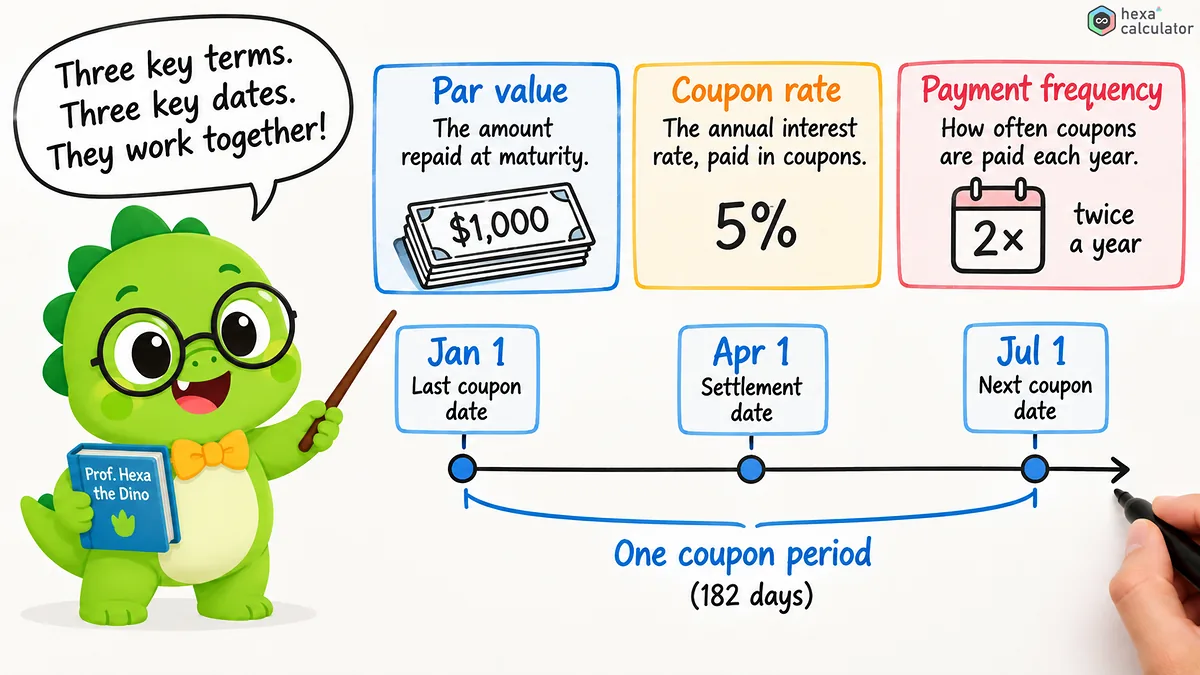
Formula to calculate interest period:
If the payment date falls within an interest period, accrued interest income is calculated by multiplying the face value with the coupon rate and then multiplying it by the percentage of time that has elapsed.
The calculation based on the interest payment period is to multiply par value by the coupon rate for an interest payment period and then by the fraction of that period which has elapsed.
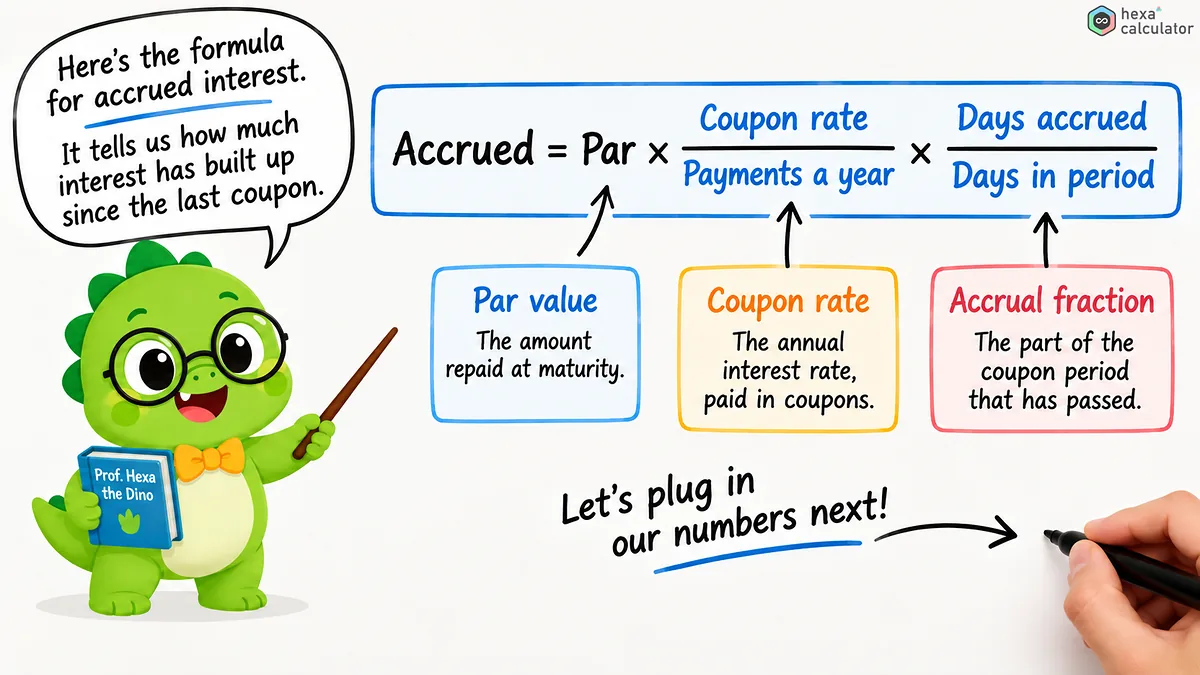
A is the number of days elapsed in the specified period and NL is the total number of days in that period. Both values are calculated according to the selected day count convention. For example, for a bond with a par value of $1,000, a 10 percent coupon rate, semi-annual payments, and a reference date of 30/360, accrued interest after sixty days from the start of the period is:
Each input is listed below alongside the value it takes in the bond above.
Symbol | Meaning | Example |
|---|---|---|
Par | Face value of the bond | 1,000 |
Rate | Annual coupon rate | 10 percent |
Frequency | Coupon payments per year | 2 |
A | Days accrued since the last coupon | 60 |
NL | Days in the coupon period | 180 |
AI | Accrued interest | 16.67 |
Practices for calculating time periods.
The method of calculating the days and the number of days in a year are determined by the calculation period used for the number of days. Please select the one that matches the terms of the bond as there may be slight differences in the result depending on the period used.
Basis | Convention | Typical use |
|---|---|---|
30/360 (US) | Every month is 30 days, the year 360 | US corporate and municipal bonds |
Actual/actual | Real days over the real period length | US Treasuries |
Actual/360 | Real days over a 360-day year | Money-market instruments |
Actual/365 | Real days over a 365-day year | Some sterling and other markets |
30/360 (European) | 30-day months, European day rules | Eurobonds |
Clean prices and dirty prices
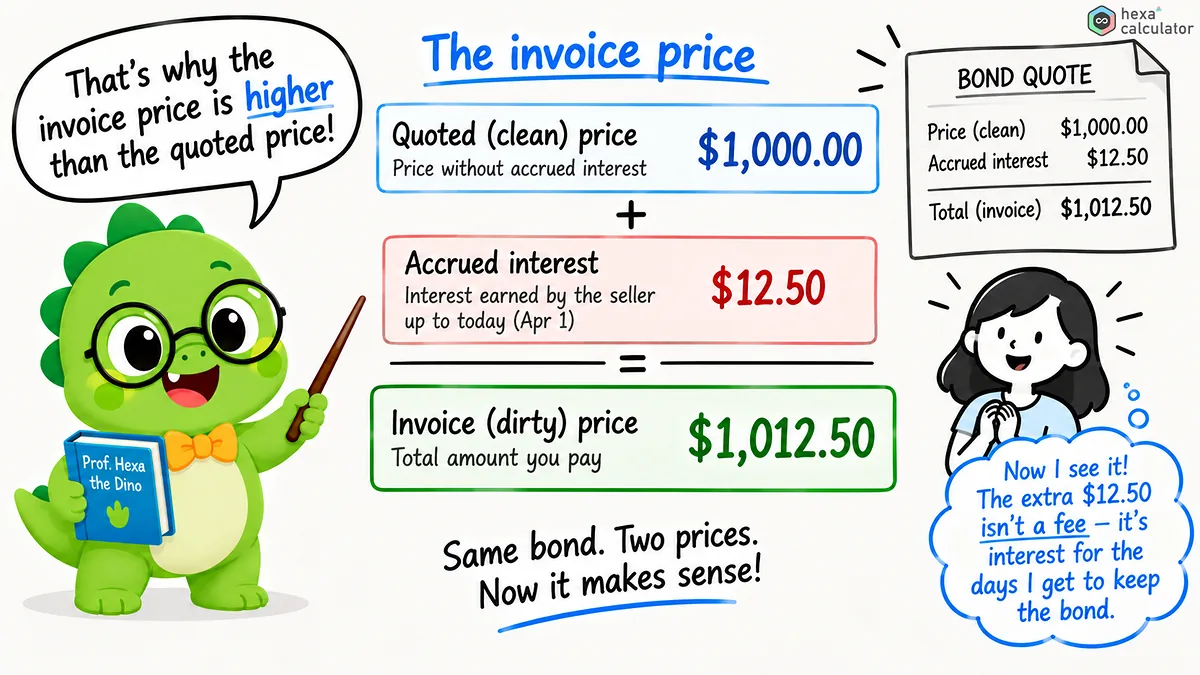
Bonds are usually quoted at a "clean" price, which does not include accrued interest. The "dirty" price is also called the settlement price or invoice amount and is the sum of the clean price plus accrued interest; it represents the actual cash payment made when settling the trade. The price shown on the screen is usually the clean price, while the actual cash payment is based on the dirty price. You can switch between the two prices by selecting "settlement price" in the calculator tool.
For an example bond with $1000 Par value, 5% coupon paid semiannually.
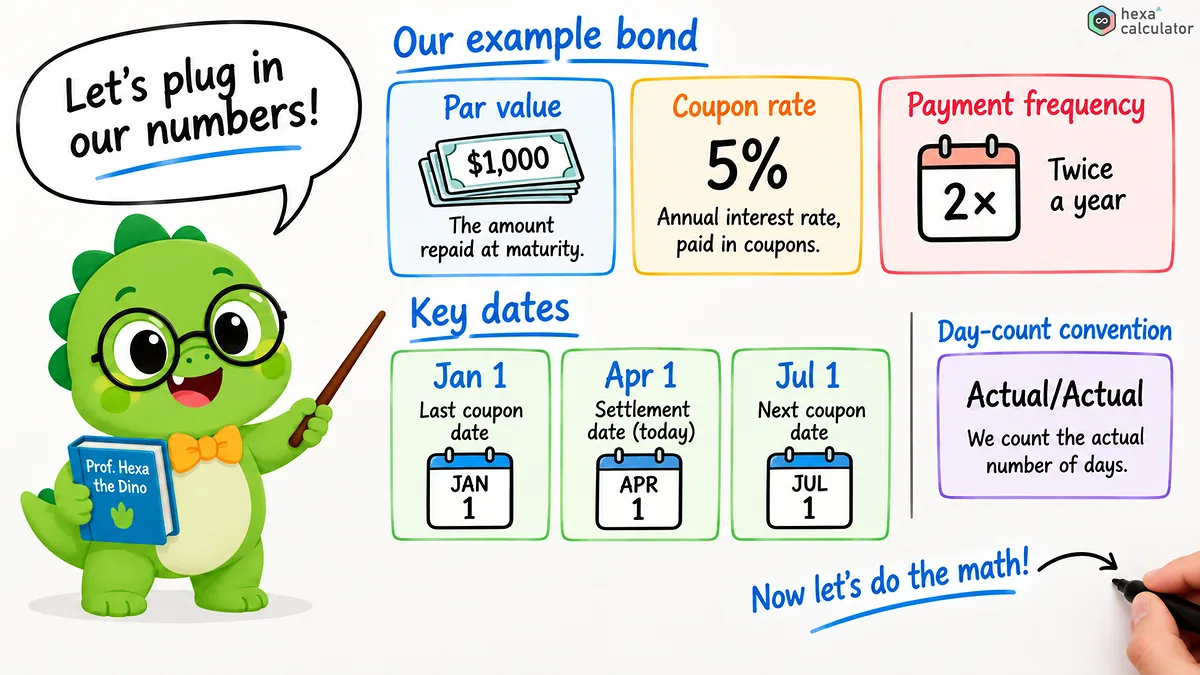
The resultant Accrued Interest turns out to be $12.50 and the Invoice (dirty) price would be $1012.5
Why accrued interest is important
Buying and selling bonds in the secondary market almost always involves a transaction that is not exactly on an interest payment date, which results in accrued interest. The accrued interest determines the settlement price stated in the trade document, and it allows for the bond's yield to be split between price changes and interest income. If the calculation of days and dates are correct, then the total settlement price for the entire portfolio can also be determined exactly.
Practical tips
Use the calculation standard actually set in the bond for the number of days and do not simply apply the default option as this can lead to different results. Enter the face value in the field "Face Value" for all bonds that are subject to this transaction, and not the price. The accrued interest belongs to the seller but is passed on to the buyer. The buyer then receives this amount back at the next full interest payment.
Frequently asked questions
What is an accrued interest on a bond?
Accrued interest on a bond is the coupon interest that has accumulated since the last interest payment date but not yet paid. If you buy a bond between two interest payment dates, in addition to the bond price, you must also pay this amount to the seller. The entire next coupon will be paid to you because the seller previously held the bond for a certain period of time.
How is accrued interest calculated?
First multiply the par value by the annual coupon rate to get the annual interest, and then multiply that result by the percentage of the past period in the current interest period. This percentage is calculated by dividing the number of days since the last interest payment date until maturity by the total number of days in the current interest period. The exact number of days is calculated according to the day count convention applicable to the bond. For example, if a bond has a par value of 1,000, a coupon rate of 5 percent and there are 91 days since the last interest payment date until maturity with a total of 182 days in this period, then the accrued interest is 12.50.
What is the difference between a "clean price" and a "dirty price"?
The "clean" price is the market offered price and does not include any accrued interest. The "dirty" price, also called settlement or invoice price, is the clean price plus the accrued interest and represents the amount that the buyer actually pays. Bonds are quoted at the clean price but settled at the dirty price.
What day payment method should be used?
Please select the convention that matches the terms of your bond. US corporate and municipal bonds typically use 30/360, US Treasury securities use actual days/actual days, and many money market instruments use actual days/360. Because the number of days is calculated differently depending on the convention, there may be slight differences in interest payments.
Does the accrued interest payment benefit the buyer or seller?
The accrued interest payment benefits the seller. When settling, the buyer pays the seller the accrued interest. The issuer then pays the full coupon amount to all those holding the bond at that time on the next interest date, thus offsetting the sum already paid by the buyer.
Related calculators
Disclaimer: This calculator is provided for general informational and educational purposes only. Our calculators are under active development, and results may be inaccurate, incomplete, or unsuitable for your situation. Always verify the figures independently and seek advice from a qualified professional before relying on them. We make no warranties and accept no liability for any loss or decision arising from use of this tool.
References
- Microsoft: ACCRINT function
Reference for the accrued-interest function and its day-count basis options.
- Investopedia: Accrued Interest
Plain-language explainer of accrued interest on bonds.
- FINRA: Accrued Interest Calculator
Investor tools from the U.S. broker-dealer regulator.