Bond Yield Calculator
Calculate a bond's yield to maturity, current yield, and effective annual yield from its price and coupon. Compare yield measures and check yield to call.
https://hexacalculator.com/calculators/finance/bonds/bond-yield-calculator
Finance
Bonds
Bond Yield Calculator
Calculate a bond's yield to maturity, current yield, and effective annual yield from its price and coupon. Compare yield measures and check yield to call.
Bond Yield Calculator
%
%
Add yield to call and yield to worst
For a callable bond that the issuer can redeem early.
Compare a tax-free yield
Match a municipal bond's yield against a taxable one, after tax.
Check interest-rate risk
See duration and how the price reacts when yields move.
Show the yield for a price swing
Estimate the yield if you pay a little more or less.
Yield to maturity
The yield to maturity beats the coupon rate, so you bought at a discount (below face value). Buying below par lifts your return above the coupon.
- Current yield
- %
- Effective annual yield
- %
- Coupon (nominal) yield
- %
- Coupon payment
- $
- Total coupon income
- $
- Gain or loss at maturity
- $
Was this calculator helpful?
It takes one click and shapes what we fix next.
Add as preferred on GoogleShow the yield measures chart
Compare the coupon, current, YTM and effective yields side by side.
Show the price-yield curve
Plot how the price changes across a range of yields.
Show the cashflow schedule
List every coupon and the final repayment, with present values.
Show the price breakdown
Split the price into the value of coupons and the value of the face amount.
Period | Years | Cashflow ($) | Discount factor | Present value ($) |
|---|---|---|---|---|
| 1 | 0.5 | 25 | 0.971 | 24.29 |
| 2 | 1 | 25 | 0.944 | 23.59 |
| 3 | 1.5 | 25 | 0.917 | 22.92 |
| 4 | 2 | 25 | 0.891 | 22.26 |
| 5 | 2.5 | 25 | 0.865 | 21.63 |
| 6 | 3 | 25 | 0.84 | 21.01 |
| 7 | 3.5 | 25 | 0.816 | 20.41 |
| 8 | 4 | 25 | 0.793 | 19.83 |
| 9 | 4.5 | 25 | 0.77 | 19.26 |
| 10 | 5 | 25 | 0.748 | 18.71 |
| 11 | 5.5 | 25 | 0.727 | 18.18 |
| 12 | 6 | 25 | 0.706 | 17.66 |
| 13 | 6.5 | 25 | 0.686 | 17.15 |
| 14 | 7 | 1,025 | 0.667 | 683.12 |
A bond's yield is the actual return on a bond and almost never matches the interest rate listed on the bond. If a bond is purchased below par value, its yield will be above the stated interest rate, and if it is purchased above par value, its yield will be below the stated interest rate.

This calculator calculates the yield to maturity based on the bond price, coupon, and time until maturity, and also shows current yield, effective annual yield, and coupon rate so you can get a full picture in one place. If you enter a yield, this tool will calculate the corresponding price. If you enter a yield, it will calculate the price required to achieve the stated yield.
What is a bond yield?
A bond is essentially a loan to a government or company. Bonds pay fixed interest, called coupons, and are repaid at face value at the end of their term. Yield captures these payments and price in an annualized return. When talking about the yield on a bond, one usually refers to the yield to maturity. This is the return that will be earned if a bond is bought at its current price, receives all coupon payments, and held until maturity. It essentially represents the internal rate of return (IRR) on the bond market.

Four types of yields
A bond has not one but several yields; each type of yield answers a different question. The coupon rate is the fixed interest rate set at the time of issue of the bond. The current yield is the annual coupon payment divided by the current price and reflects only income. The yield to maturity is the most comprehensive measure, as it takes into account both the interest payments and any gains or losses that will be realized when the bond's price reverts back to its face value at the end of its term. The effective annual yield represents the yield to maturity in a way that accounts for the effects of compounding within one year, allowing bonds with different coupon payment schedules to be compared.
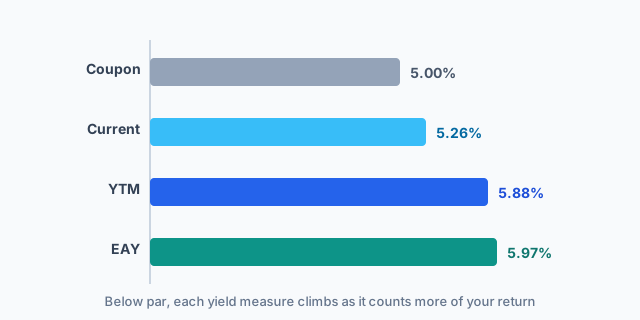
For a bond purchased below par, the four types of yields increase in the following order: coupon yield, current yield, yield to maturity and finally effective annual rate. If a bond is purchased above par, then the order is reversed. Comparing these values side by side is the quickest way to understand how bonds are priced.

Instructions for using this calculator:
Enter the bond price, par value, annual coupon rate, number of years remaining until maturity date and frequency of interest payments. The calculator will calculate the yield and display the result. If you want to calculate a yield backwards, enter your desired yield and clear the price to get the price required to achieve that yield. For more detailed analysis, you can open additional options. Here you can see the prepayment yield for bonds that can be prepaid by the issuer, the tax-equivalent yield of municipal bonds, the duration to assess interest rate risk, and the range of price sensitivity which indicates how the yield changes when the purchase price fluctuates slightly.
Understanding the formula for yield to maturity.
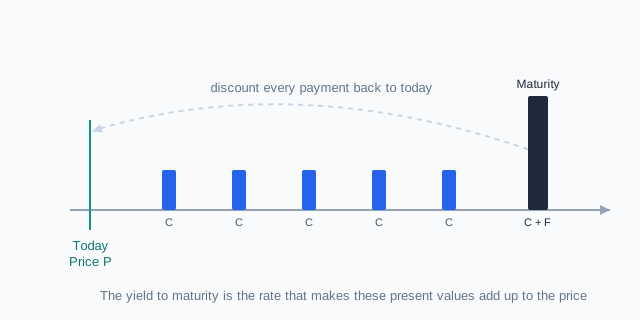
The yield to maturity is the interest rate at which the present value of all future payments equals the price paid. Since it's not possible in this equation to isolate and extract just the interest rate, the calculator uses numerical algorithms to find the interest rate.

where P is the price, C is the coupon per period, F is the face value, N is the number of periods and i is the yield per period. The coupon per period is the product of the annual coupon rate and the face value divided by the number of payments per year. When the calculator finds a value for i, it displays an annualized value.
Suppose a bond has a price of 950, a par value of 1,000, a coupon rate of 5 percent, pays interest semi-annually and has 7 years to maturity.

The coupon amount per period is 25 and the number of periods is 14. The result shows a yield per period of approximately 2.94 percent.
If you double that, the yield to maturity is about 5.88 percent.

The effective annual rate is about 5.97 percent while the current yield is approximately 5.26 percent, which is calculated by dividing 50 by 950. All three values exceed the nominal interest rate of 5 percent. This is because this bond was purchased at a discount price. The following table summarizes each input in this example and provides the corresponding value.
Symbol | Meaning | Example |
|---|---|---|
P | Bond price (clean) | 950 |
F | Face or par value | 1,000 |
Coupon rate | Annual coupon as a percent of face | 5 percent |
C | Coupon paid each period | 25 |
m | Payments per year | 2 |
N | Number of periods to maturity | 14 |
i | Yield per period (solved) | about 2.94 percent |
YTM | Yield to maturity (annual) | about 5.88 percent |
Why yields diverge from nominal interest rates
The nominal interest rate is set when a bond is issued while the price changes daily in the market. If the price falls below par, the same interest payment combined with the gain made if the price recovers to par will result in an overall higher return. So the yield is higher than the nominal interest rate. If the price rises above par, the yield is lower than the nominal interest rate. Price and yield always move in opposite directions.
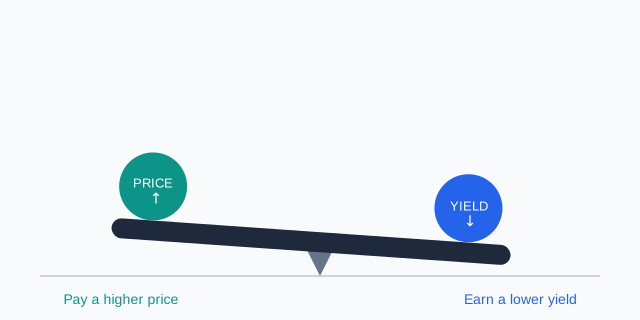
This also explains why the yield of a bond will gradually approach its coupon rate over time as it gets closer to maturity. With less time left, there is less impact from gains or losses and the price pulls back towards par value. Traders call this phenomenon "pull to par".
Early repayment yield and minimum yield
Many bonds are callable, meaning that the issuer can buy back the bond early at a usually fixed price, typically when interest rates have fallen. This limits upside potential so that the yield to maturity may overstate actual return. Yield to call is calculated in the same manner except that the date and price of the call are used as the end point. The minimum yield is the lower of the two. When comparing callable bonds this figure should be considered since it represents the worst case outcome.

Factors that affect bond yields include:
Yield varies with the overall economic environment. When inflation rises, yields tend to rise as well. This is because investors want their capital to keep pace with inflation and central banks often raise interest rates in response. Credit risk also affects yield. Issuers with weaker credit ratings must offer higher yields to attract buyers. So a significantly higher yield than similar bonds is usually not a sign of a bargain, but rather a warning. Maturity is also important, as longer-term bonds carry more interest rate risk and therefore often offer slightly higher yields.
Tips for understanding bond yields:
Compare the effective annual yield for different coupon payment schedules. This allows you to compare on a level playing field. Note that current yield is a snapshot of earnings and not total return as it ignores the effect of getting back to par value. Match your coupon frequency with the bond in question, most corporate bonds and US Treasury bonds pay interest semi-annually. For callable bonds do not rely on the stated yield to maturity but rather the minimum yield.
Frequently asked questions
Is a bond's yield equal to its rate of return at maturity?
In most cases yes. When talking about the yield of a bond, one is usually referring to the yield to maturity. This is the annualized rate of return earned when holding a bond until maturity and reinvesting the coupon payments received at that rate. The current yield and coupon rate are more narrow measures and do not take into account any gain or loss realized as the price of a bond reverts back to par value.
Why is my bond's yield to maturity higher than its coupon rate?
This is because the purchase price was below the bond's par value. You not only receive the interest coupon but also the par value at maturity, which gives you the difference between the discounted price and the par value as additional profit. This extra profit makes your total return higher than the nominal rate of interest. If you buy a bond above its par value, it is the opposite, and the yield will be below the nominal rate of interest.
What are the differences between current yield, maturity yield and nominal interest rate?
The nominal rate is a fixed interest rate set at the time of issuance of a bond. The current yield is the result of dividing the annual coupon by the purchase price and measures only income. Yield to maturity is the most comprehensive indicator of them all, as it takes into account both gains or losses that will be realized when the price reverts back to par value at maturity.
What are the early repayment and minimum yields?
The yield to call is the return that will be earned if the issuer of a bond does not hold it until maturity but buys it back at the first call date for the price of a call. The minimum yield is either the yield to call or the yield to maturity, whichever is lower. For bonds with a call option, use the minimum yield because it takes into account the worst-case scenario.
Can bonds have a negative return?
Yes it is possible but not common. When the price of a bond is so high that the sum of coupon payments and face value falls short of the price paid then there will be negative yield. In times when central bank rates are extremely low or even negative some government bonds have been in this situation. In such cases investors were willing to accept a small loss in exchange for some security.
Related calculators
Disclaimer: This calculator is provided for general informational and educational purposes only. Our calculators are under active development, and results may be inaccurate, incomplete, or unsuitable for your situation. Always verify the figures independently and seek advice from a qualified professional before relying on them. We make no warranties and accept no liability for any loss or decision arising from use of this tool.
References
- Investor.gov: Bonds
U.S. SEC overview of how bonds work and what affects their yield.
- Investopedia: Bond Yield
Definitions and formulas for current yield, yield to maturity, and more.
- U.S. Department of the Treasury: Daily Treasury Par Yield Curve Rates
Current Treasury yields to use as a market reference.