WACC Calculator
Free WACC calculator: find the weighted average cost of capital from equity, debt, costs, and tax. CAPM cost-of-equity helper, ROIC check, and reverse solve.
https://hexacalculator.com/calculators/finance/corporate-finance/wacc-calculator
Finance
Corporate Finance
WACC Calculator
Free WACC calculator: find the weighted average cost of capital from equity, debt, costs, and tax. CAPM cost-of-equity helper, ROIC check, and reverse solve.
WACC Calculator
Estimate the cost of equity with CAPM
Build the cost of equity from a risk-free rate, beta, and equity risk premium.
Compare WACC with return on invested capital
Check whether the business earns more than it pays for capital.
Weighted average cost of capital
- Equity weight
- %
- Debt weight
- %
- After-tax cost of debt
- %
- Pre-tax WACC
- %
- Tax shield saving on WACC
- %
- Total capital
- $
- Annual interest tax shield
- $
Because interest is tax-deductible, the tax shield trims your WACC by 0.42%, from a pre-tax 8% to 7.58%.
Equity funds 60% of your capital and debt funds 40%. Equity usually costs more, so it carries the larger share of the rate.
Was this calculator helpful?
It takes one click and shapes what we fix next.
Add as preferred on GoogleShow the capital structure split
Equity versus debt as a share of total financing.
Show what drives the WACC
How much of the rate comes from equity versus after-tax debt.
How your capital splits between equity and debt.
How much of the WACC comes from equity vs after-tax debt.
The weighted average cost of capital (WACC) is the overall rate that a company pays to raise capital. It combines the costs of equity, which accrues to shareholders, with the costs paid to lenders and is weighted according to the proportion of each source of funding. Analysts typically use it as a discount factor in discounted cash flow models and as the minimum return new projects should achieve. This calculator allows for bi-directional calculations. If you enter equity, debt, their respective costs, and the tax rate, then WACC will be calculated. Conversely, any field can be left blank to solve for that input value.
What is WACC?
Any company financing is essentially composed of two types of funding sources, each with its own price tag. Equity holders bear the risk of ownership in a business and expect a return on their investment. Creditors, on the other hand, receive interest payments. The WACC weighs these two funding sources according to their proportion of total funding and combines those two prices into one single percentage. This result is the minimum rate of return that a company must earn from its assets to satisfy both equity holders and creditors. If returns exceed the WACC, then the business creates value; if they fall below it, then the business destroys value.
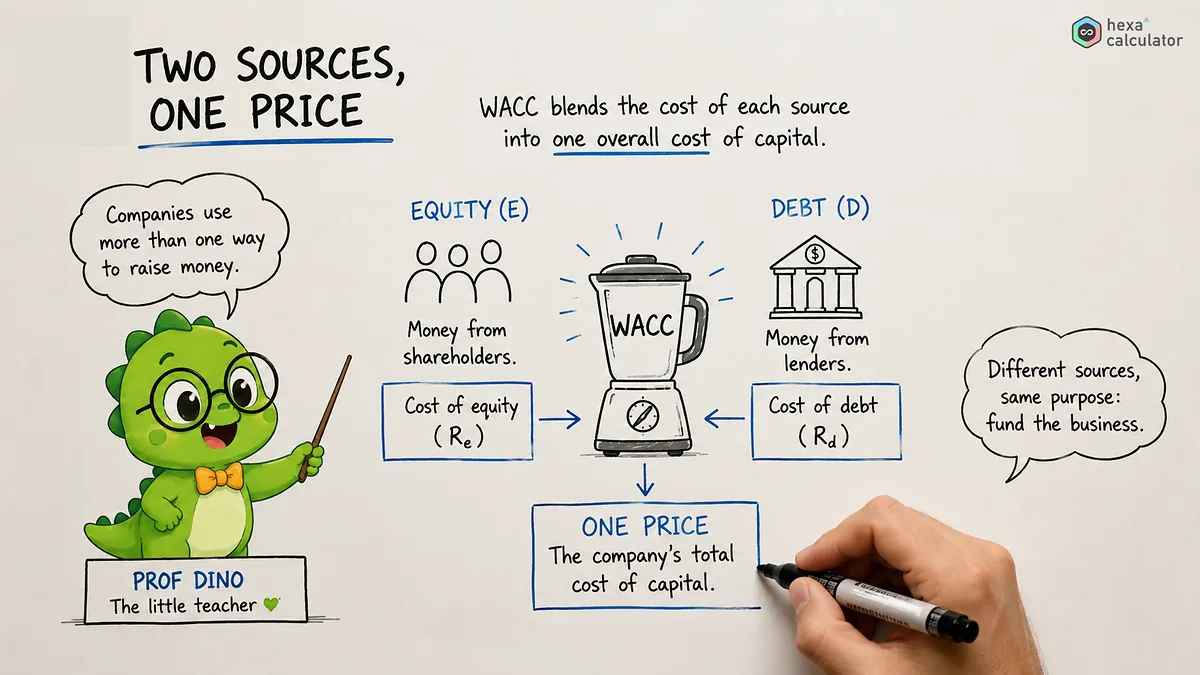
Prof. Hexa the Dino explains what is WACC, how it is calculated and what is its purpose.
Formula for Calculating WACC
The WACC is calculated by weighting the cost of equity and the after-tax cost of debt according to their proportion in total capital.
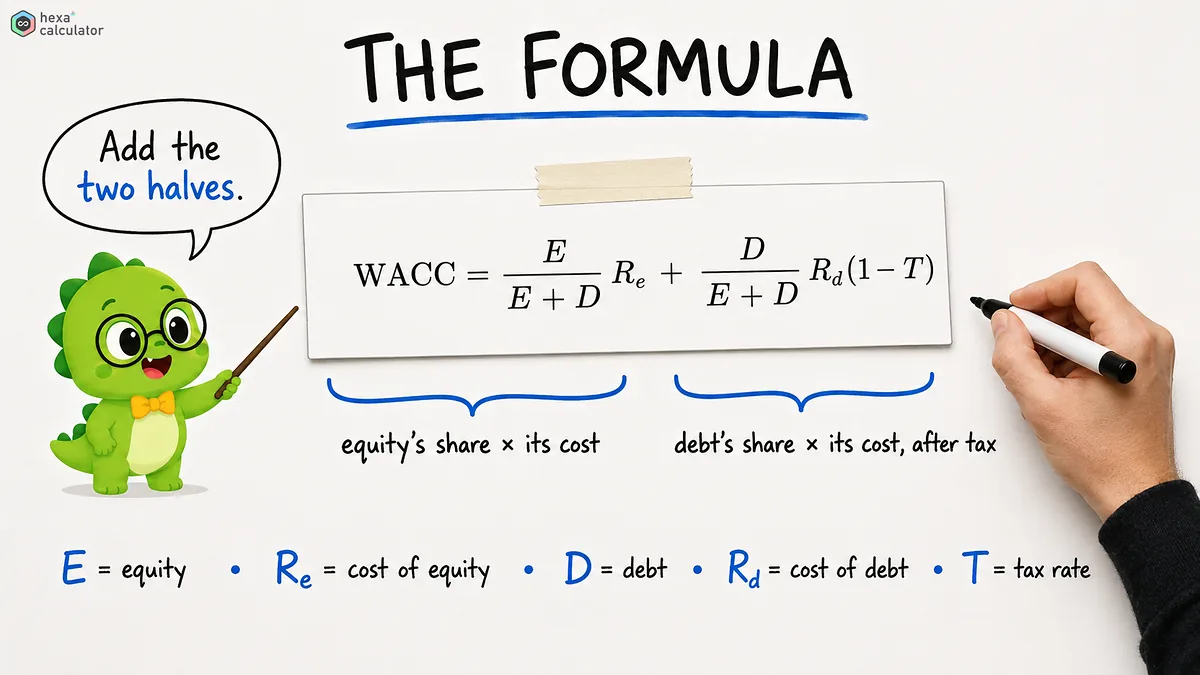
is the market value of equity, is the market value of debt, are the cost of equity, are the cost of debt, and is the corporate tax rate. The term represents the tax benefit. Since interest is tax deductible, it only costs you $ after taxes.
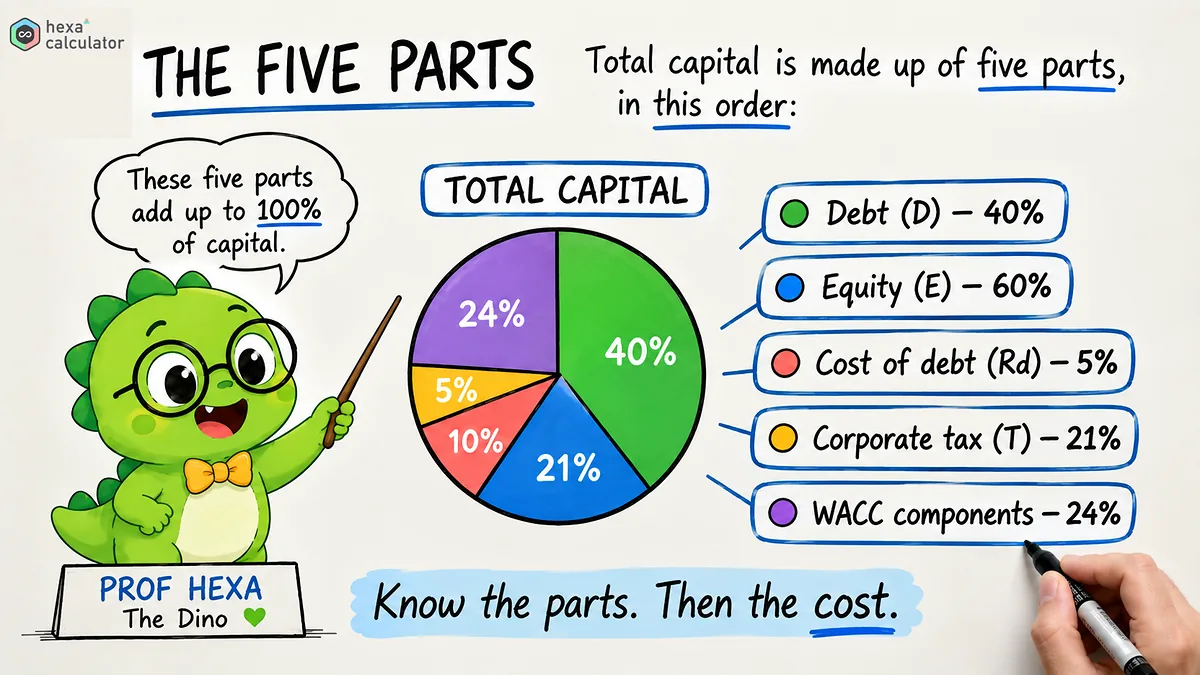
The image above shows what the total capital is made up of and what is the cost. The five parts add up to 100% of the capital. This will be clear as we get to the example below.
The following table maps the individual symbols to the corresponding entries in this calculator and shows examples of their use throughout the text.
Symbol | Meaning | Example |
|---|---|---|
E | Market value of equity | 60 million |
D | Market value of debt | 40 million |
Re | Cost of equity | 10 percent |
Rd | Cost of debt | 5 percent |
T | Corporate tax rate | 21 percent |
WACC | Weighted average cost of capital | result |
Full calculation scenario:
Suppose a company is financed with $60 million equity and $40 million debt, for a total capitalization of $100 million. The equity makes up 60 percent of the financing structure while the debt makes up 40 percent. The cost of equity is 10 percent, the cost of debt is 5 percent, and the tax rate is 21 percent. First, the cost of debt will be adjusted to account for the tax benefit.
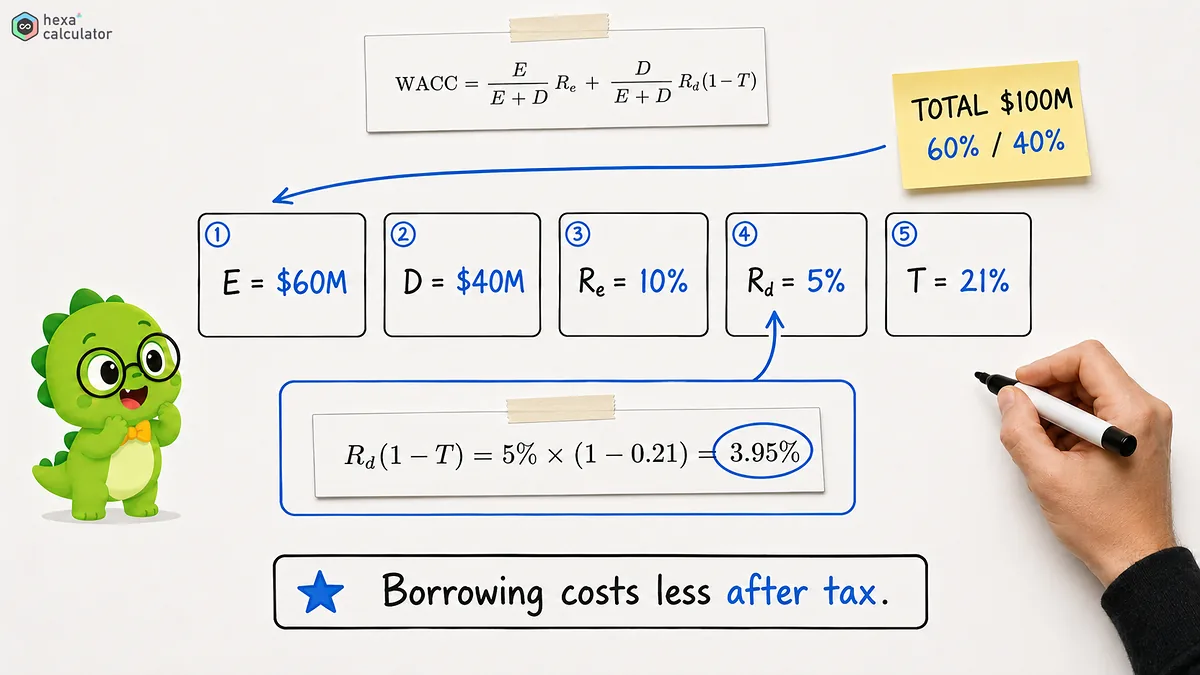
The after tax borrowing costs calculations are shown above in the picture, even though the Cost of Debt is higher, due to the interest tax shield the effective cost of borrowing is lower as shown in the image above.
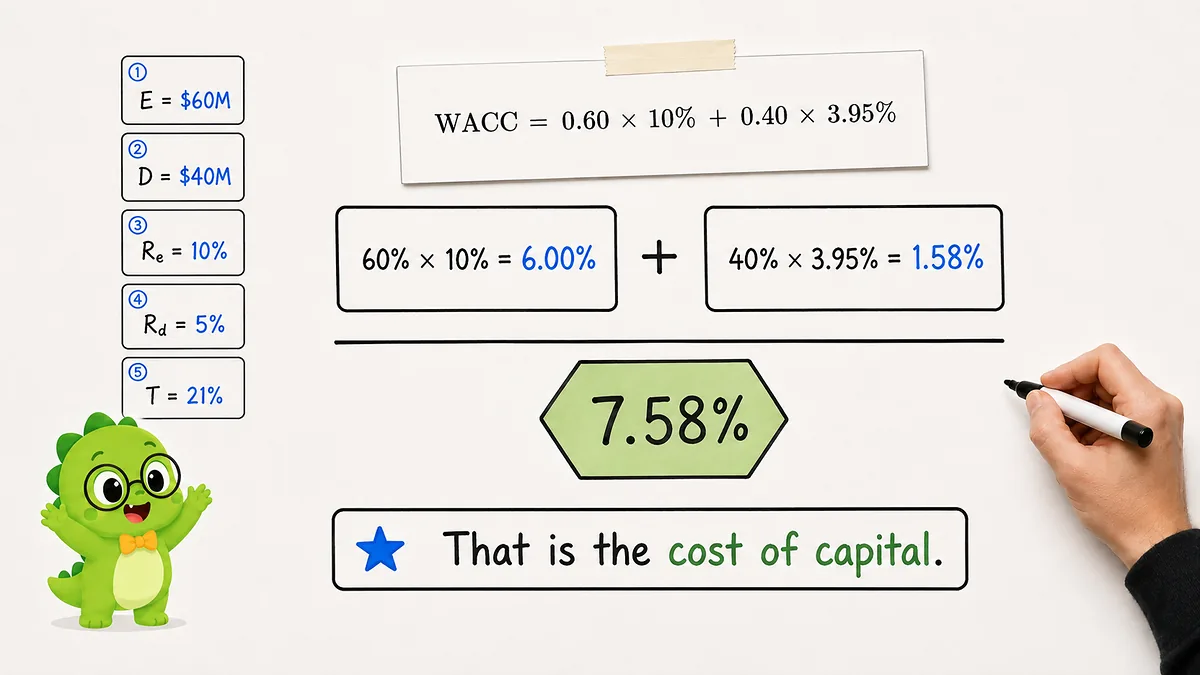
The two cost types are then weighted according to their share of capital and added, resulting in the Weighted Cost of Capital.
The equity makes up 60 percent of the funding but contributes 6.00 percentage points (7.58 total) to the WACC and represents about 79 percent of the total amount. As equity is a more expensive source of financing, its impact on interest rates outweighs the value in the balance sheet. Without the tax benefit, the interest would be 8.00 percent, so in this example, the deductible interest saves approximately 0.42 percentage points.
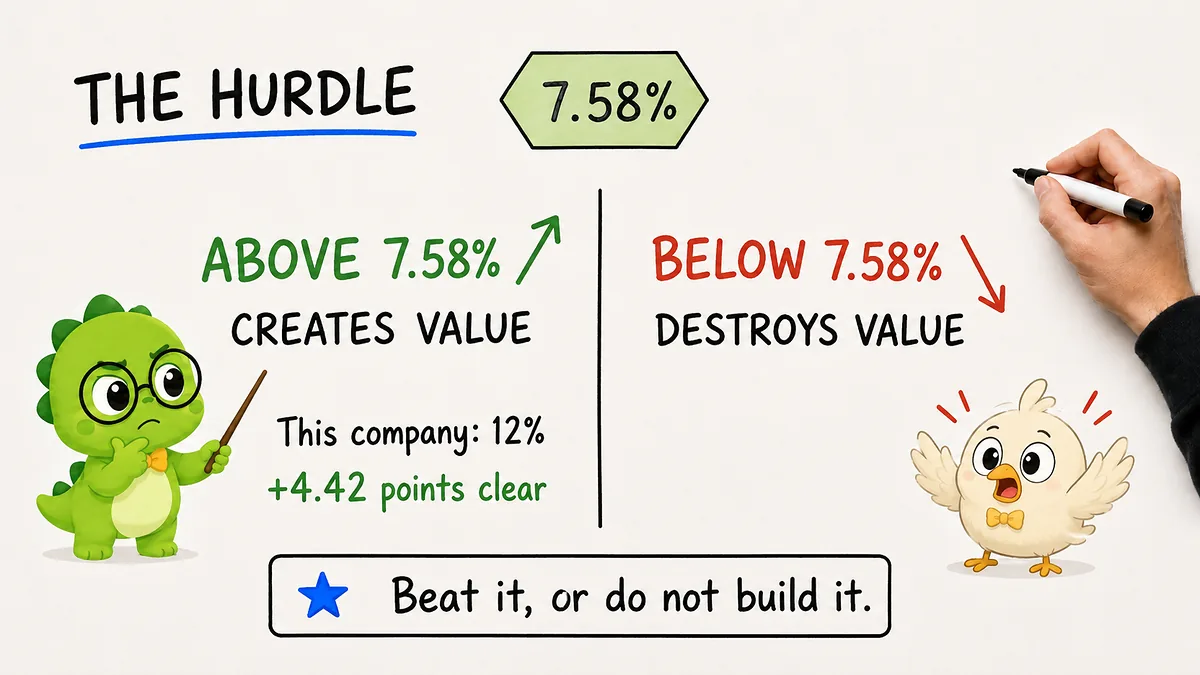
Any rate of return the company generates over the WACC, the company would create value and any rate of return below it will destroy value.
Estimating cost of equity capital using the CAPM.
The cost of debt is easy to observe as it is represented by the yield on corporate bonds or interest rates that a company pays when borrowing money. The cost of equity, however, is more difficult to determine since shareholders do not bill for their services. The most common method of estimating this is through the Capital Asset Pricing Model (CAPM).
is the risk-free rate of return, typically the yield on a 10-year government bond. measures the volatility of the stock relative to the market. is the equity risk premium, which in developed markets is normally between 4.5 and 6 percent. If the risk-free rate is 4.5 percent, the beta is 1.2, and the premium is 5.5 percent, then the cost of equity is . With a CAPM calculator function in a spreadsheet tool, you can derive this value from the individual components. If it's difficult to pin down the inputs for the CAPM, dividend discount models or adding a risk premium to the bond yield are workable alternatives.
Why debt can be cheap and when leverage becomes unproductive
In most cases, the cost of debt is lower than the cost of equity. Lenders have a priority claim on cash flows and assets, which means they take less risk than shareholders and therefore accept lower returns. Additionally, companies can deduct interest payments from their taxes. Therefore, adding debt to a company's capital structure will usually reduce its weighted average cost of capital (WACC). However, this effect is not unlimited. As leverage increases, the financial risk that lenders and shareholders face also increases, which leads to higher costs of both debt and equity. Once a certain threshold is reached, the increased costs outweigh the benefits of adding cheaper capital, and the WACC begins to rise again. Because of this trade-off, there is an optimal capital structure for each company that minimizes its cost of capital, and it is not always easy to maximize the amount of debt in the capital structure.
Typical WACC values by industry
There is no ideal WACC that applies to all companies. The appropriate value depends on the business risk. Industries with stable cash flows, high capital requirements and strong regulation tend to have lower values while more risky and growth-oriented industries will have significantly higher values. The following ranges are only rough guidelines and not target values.
Sector | Typical WACC |
|---|---|
Utilities and regulated infrastructure | 5 to 7 percent |
Real estate and consumer staples | 6 to 9 percent |
Industrials and established manufacturers | 8 to 10 percent |
Technology and software | 9 to 13 percent |
Biotech and early-stage growth | 12 percent and up |
WACC, ROIC, Minimum return
WACC (Weighted Average Cost of Capital) is most effective when considered in combination with a profitability ratio. Return on Invested Capital (ROIC) measures the actual return that a company generates from its invested capital. WACC represents the required rate of return, while ROIC represents the actual return achieved. If ROIC exceeds WACC, there is a positive spread, indicating that the company is creating economic value. If ROIC falls below WACC, it can hinder growth and even destroy value. Companies with consistently high ROICs above their WACC are typically examples of sustainable growth. The hurdle rate is closely related to this concept. It represents the minimum return that a particular project must generate, often based on the WACC. However, if a project has higher or lower risk than the company overall, the hurdle rate will be adjusted accordingly. ROIC comparison allows you to directly assess this spread.
Use of market value instead of book value
As much as possible, equity and debt should be weighted based on their market values. The market value of equity is the product of the stock price and number of shares outstanding. The market value of debt is the prices at which bonds are trading. If bonds are not traded, book value is adjusted for current interest rates. Book value is based on historical accounting records and indicates how much capital was raised many years ago, while it does not reflect what return investors expect today. WACC should take into account the latter. Using book value is a common simplification but if there is a large difference between stock price and equity book value this can lead to biased results.
Common mistakes to avoid
Most faulty estimates of the WACC can be traced to a handful of common errors. Mixing book and market values leads to incorrect weighting. Since the WACC is forward-looking, ideally the marginal tax rate should be used rather than the effective tax rate, otherwise it will underestimate the tax savings. Another serious but often overlooked source of error is faulty cash flows and interest rates. The WACC is applied to a company's free cash flows, not equity-free cash flows, which should be considered separately. If a company has a significant amount of preferred stock, this should be taken into account since otherwise an important source of financing will be excluded from the average. Additionally, the WACC should be recalculated in the event of changes to the capital structure or interest rate environment to avoid routinely using last year's values.
Frequently asked questions
What is a reasonable WACC?
There is no one common target for all companies. The appropriate WACC will depend on the business risk. Utilities or other stable and regulated businesses will typically have a WACC of 5-7%, while mature industrial firms will typically have a WACC of about 8-10%. Riskier technology or biotech firms can have a WACC of over 12%. Companies should not focus on absolute numbers, but compare themselves to similar companies in the same industry.
How is equity's cost of capital estimated?
The most common method is the Capital Asset Pricing Model (CAPM). The cost of equity capital is the sum of the risk-free rate, beta and multiplying it by the equity risk premium. For example, if the risk-free rate is 4.5 percent, beta is 1.2 and the premium is 5.5 percent, then the cost of equity capital is 11.1 percent. Alternatively, a dividend discount model or adding a risk premium to bond yields can be used.
Why is market value used instead of book value?
The market value reflects the return that investors are currently demanding for equity and debt. This is what WACC (weighted average cost of capital) attempts to measure. Book value is historical accounting data captured at the time of original capital raising. If there is a discrepancy between stock price and book equity, results can be skewed if book value is used to weight.
Why is a post-tax percentage used for cost of debt?
Interest payments are tax-deductible, which means that interest reduces taxable income and the actual cost to a company after taxes is only (1 - T) dollars. By multiplying the cost of debt by (1 - T), the tax benefit of interest can be accounted for. This is one of the main reasons why increasing leverage can decrease WACC.
Can WACC be negative?
In practice no. For that to happen both the cost of equity and debt would have to be negative which is not possible in a going concern company. A very low WACC indicates that the company has little risk and is mostly financed by debt. However as long as investors expect positive returns this value will remain positive.
Related calculators

Disclaimer: This calculator is provided for general informational and educational purposes only. Our calculators are under active development, and results may be inaccurate, incomplete, or unsuitable for your situation. Always verify the figures independently and seek advice from a qualified professional before relying on them. We make no warranties and accept no liability for any loss or decision arising from use of this tool.
References
- Investopedia: Weighted Average Cost of Capital (WACC)
Definition, formula, and worked examples for WACC.
- Corporate Finance Institute: WACC
Step-by-step WACC build-up with cost of equity and debt.
- NYU Stern (Damodaran): Cost of Capital by Industry
Reference dataset of cost of capital across industries.