Acceleration Calculator
Find acceleration from velocity change (a = Delta v / t) or from force and mass (a = F / m). Solve for any variable, with displacement and g-force, in any unit.
https://hexacalculator.com/calculators/physics/mechanics/acceleration-calculator
Physics
Mechanics
Acceleration Calculator
Find acceleration from velocity change (a = Delta v / t) or from force and mass (a = F / m). Solve for any variable, with displacement and g-force, in any unit.
Acceleration Calculator
Please input values into the fields
Fill in the fields on the left and the acceleration appears here. In velocity mode, leave any one field blank and the calculator solves for it.
Was this calculator helpful?
It takes one click and shapes what we fix next.
Add as preferred on GoogleShow the velocity-time graph
A line from the initial to the final velocity. Its slope is the acceleration.
This acceleration calculator allows you to calculate the rate at which an object is speeding up or slowing down. Select the method of calculation that corresponds with the conditions given. There are two methods: one for calculating based on a change in velocity over a period of time, and another for calculating based on the resulting force acting upon an object of known mass. The calculator will automatically process units and display the result, as well as relevant values such as the value in multiples of Earth's gravity or displacement. In the Velocity Change mode, you can also leave any fields blank to calculate the corresponding values.
What is acceleration?
Acceleration is the rate of change in velocity over time. Since velocity indicates not only how fast an object is moving but also its direction, acceleration occurs when an object speeds up, slows down, or changes direction. Acceleration is a vector quantity and therefore has both magnitude and direction. The standard unit for acceleration is meters per second squared (m/s²). This represents the rate at which velocity (in meters per second) changes every second.
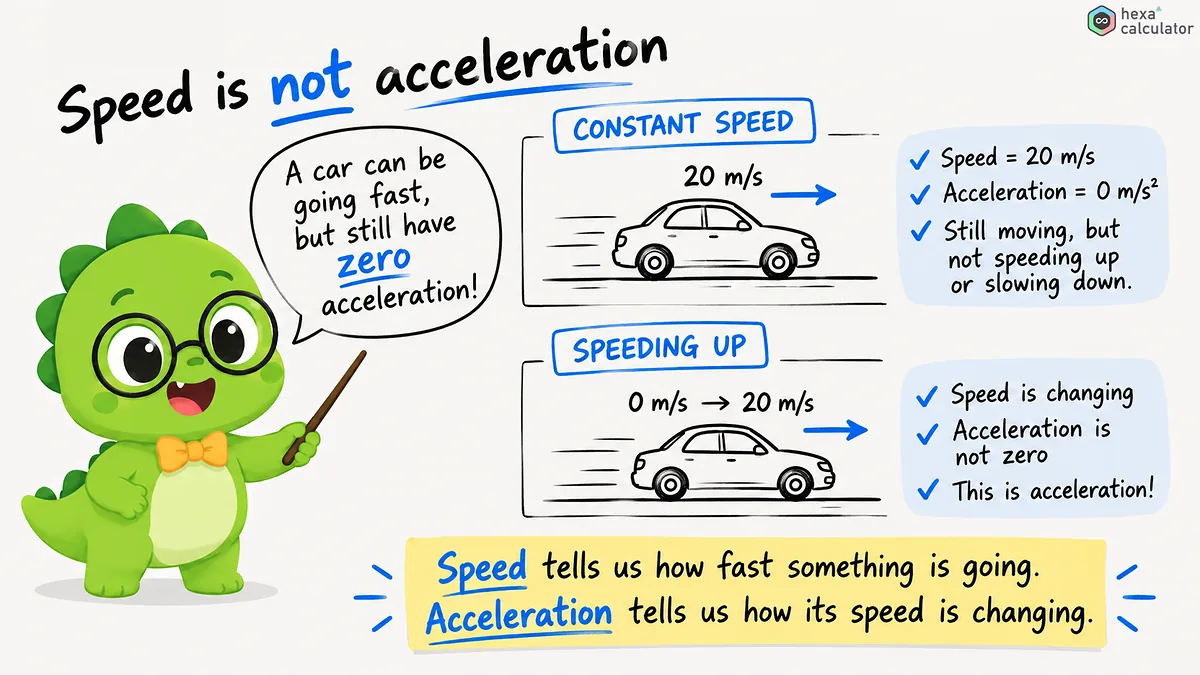
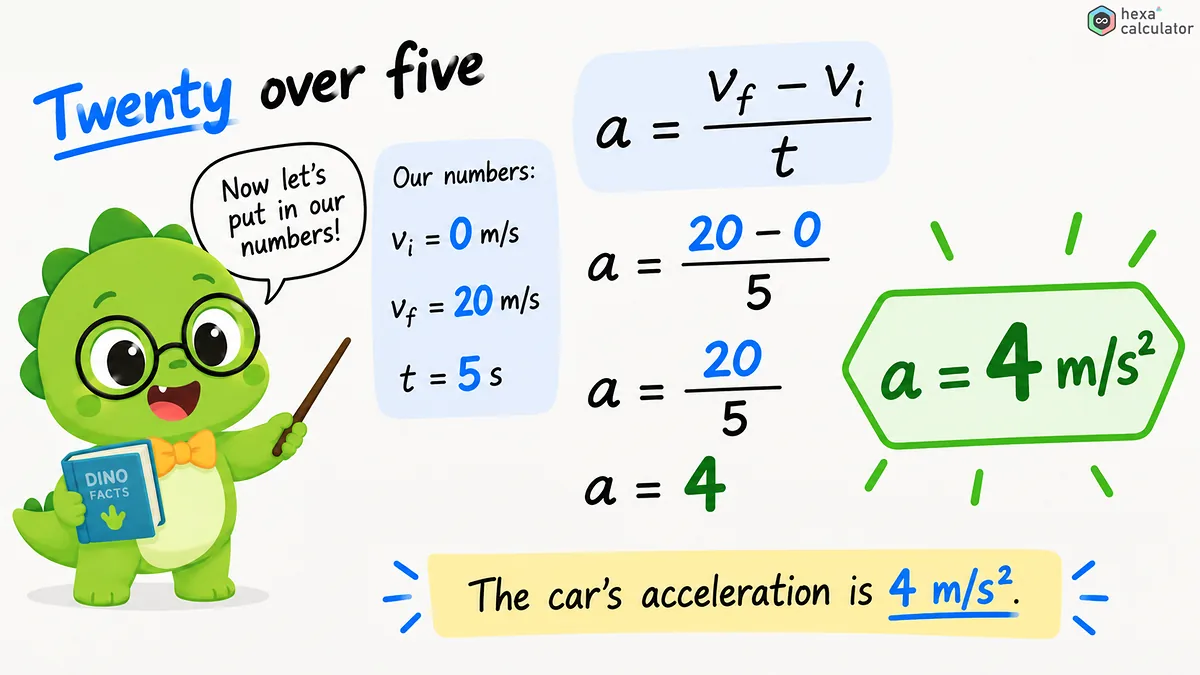
For example, if a car accelerates from rest to a speed of 20 m/s in 5 seconds, its acceleration would be 4 m/s² because the velocity is increasing by 4 m/s every second. A negative value for the result indicates that the object is decelerating.
Here's how to use this calculator:
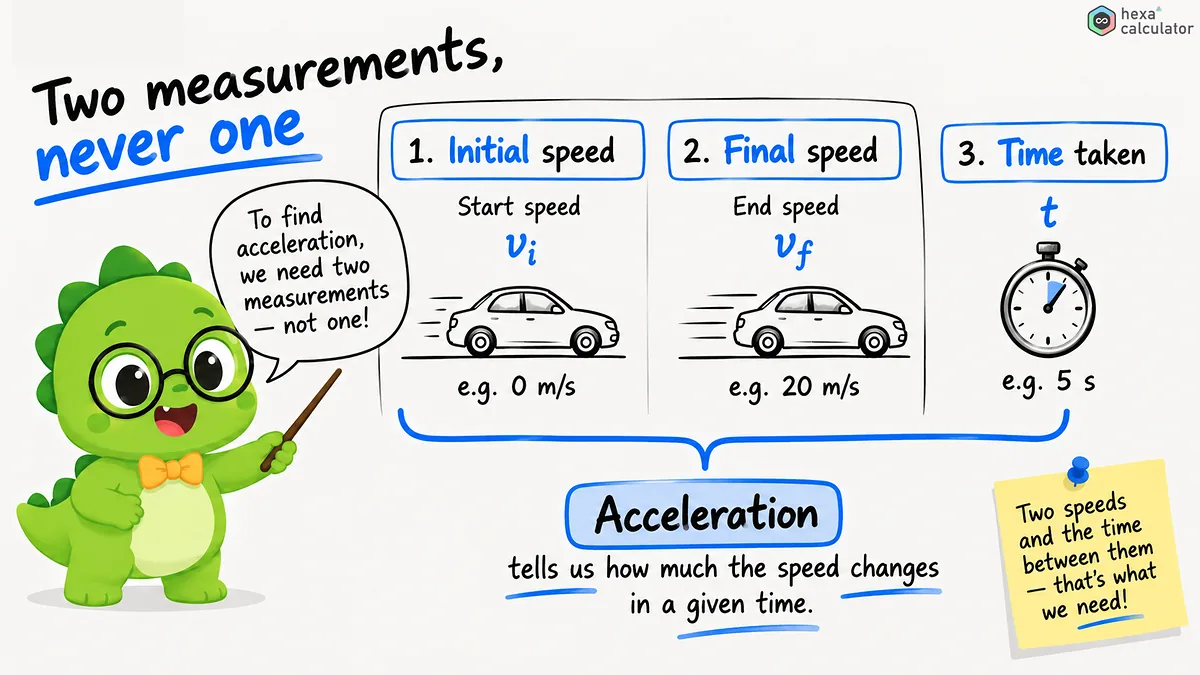
First select the calculation method. In the change in velocity mode enter the initial velocity (enter 0 if the object is moving from rest), final velocity, and time. The acceleration will be shown as the main result, along with the displacement, change in velocity, and value in multiples of Earth's gravity. These four quantities are related by the same equation so you can leave any fields blank for the calculator to calculate those values. For example if you enter acceleration and time you'll get the final velocity. In the force and mass mode you can calculate the acceleration by entering the resultant force and mass. You can also enter an acceleration and either calculate the force or mass.
Two formulas for acceleration
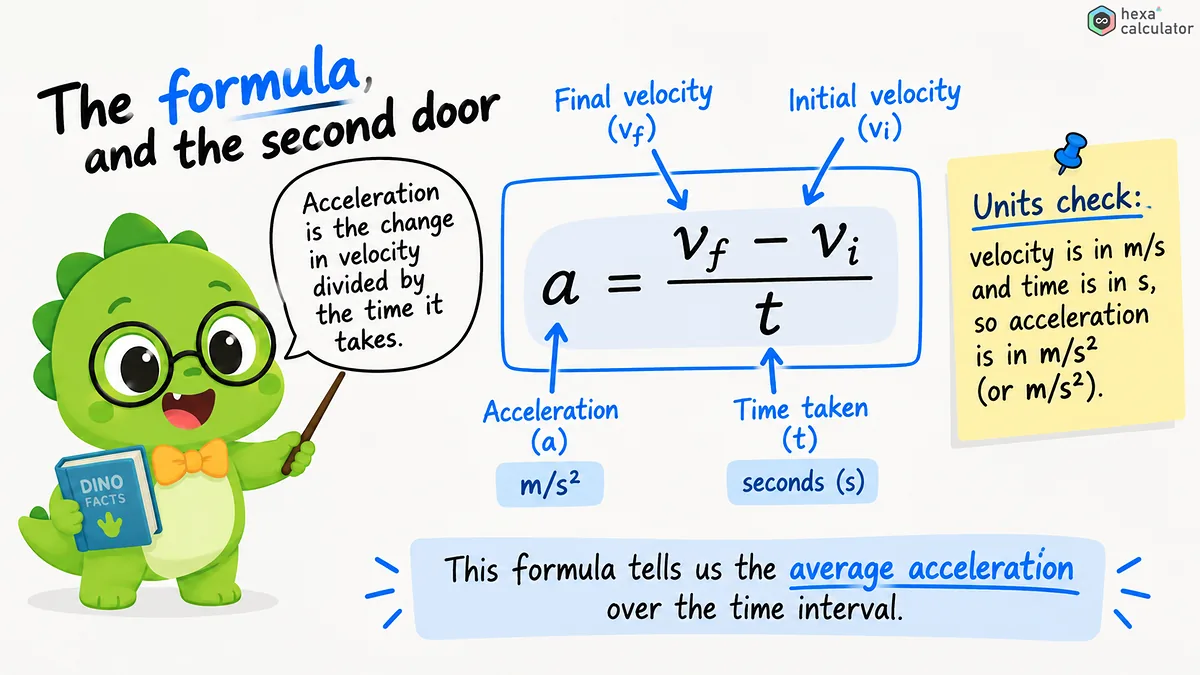
The first method uses the definition of average acceleration, which is change in velocity divided by time.
In this equation, "a" stands for acceleration, "v_i" and "v_f" stand for initial velocity and final velocity respectively, and "t" represents the time it takes for the change in velocity to occur.
The second method is based on Newton's Second Law of Motion: The net force acting upon a body equals the mass times the acceleration.
So the rule is this: if mass remains constant, acceleration will be greater with a larger force. With an equal force, acceleration will be smaller with a larger mass. The unit of force is Newtons, the unit of mass is kilograms, and the unit for calculated acceleration continues to be m/s².
Uniformly accelerated motion equations
When acceleration is constant, speed, time and distance can be related to each other through a set of equations (commonly referred to as SUVAT equations or kinematic equations). Even if one of these quantities is unknown, these equations can be used to determine the result.
Displacement, or the distance traveled along a straight line, is also the product of average velocity and time. This calculator will display the result for displacement in this format:
The last equation shows that the square of final velocity is equal to the square of initial velocity plus 2ad. It's particularly useful when time is unknown and distance is known. Rearranging this equation to solve for acceleration, we get: a = (v_f² - v_i²) / (2d).
Example of a speed calculation:
A cyclist is initially traveling at a speed of 3 meters per second, then increases his speed to 11 meters per second by pedaling harder for 4 seconds. The difference between the final and initial speeds is divided by time.
In those 4 seconds the cyclist's displacement is equal to (3 plus 11) divided by 2, times 4, which equals 28 meters. The acceleration of 2 m/s² is about one-fifth of Earth's gravitational acceleration g.
An example of a force calculation:
A crate with a mass of 5 kilograms is placed on a smooth surface and experiences a force of 50 newtons. Divide the force by the mass.
The box accelerates at a rate of 10 meters per second squared toward the force. If the mass is doubled to 10 kilograms while the force remains the same, the acceleration will be half as much, or 5 meters per second squared.
The meaning of individual results:
In addition to acceleration, the calculator also displays the following values:
Result | Meaning | How it is found |
|---|---|---|
Acceleration | Rate of change of velocity | Change in velocity over time, or force over mass |
Displacement | Straight-line distance traveled | Average velocity times time |
Change in velocity | How much the speed changed | Final velocity minus initial velocity |
g-force | Acceleration as multiples of gravity | Acceleration divided by 9.81 m/s squared |
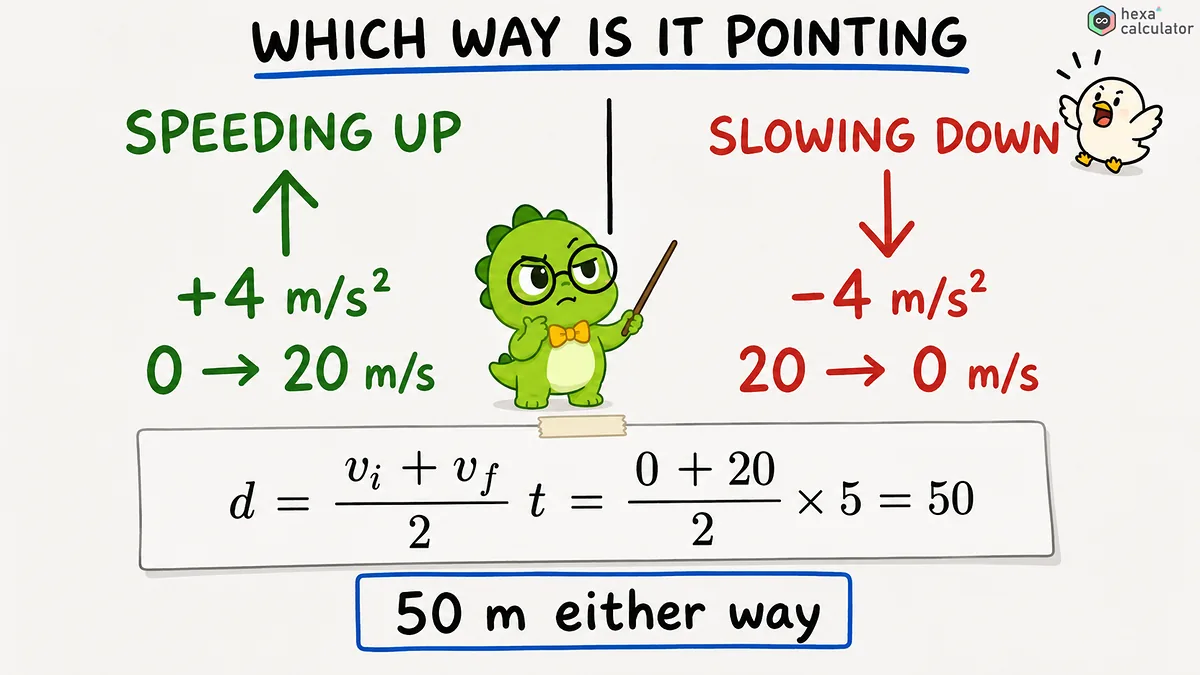
Whether it is acceleration or deceleration, it takes the same amount of distance keeping the time constant to transition between initial and final velocities as shown in the image above.
How to read a speed-time graph:
When a graph is plotted with speed on the vertical axis and time on the horizontal axis, constant acceleration appears as a straight line. The slope of this line corresponds to the acceleration, so a larger slope means that the object's speed is increasing more quickly. A horizontal line indicates that the speed is not changing, while a downward sloping line indicates that the object is slowing down. Since the area under the line equals the displacement, the greater the average speed over a given time period, the greater the distance traveled.
Applications of acceleration in everyday life.
Many everyday physical phenomena are related to acceleration. Car performance is often rated by the time it takes to accelerate from 0 to 60, which is actually an average acceleration. Engineers design braking systems and shock absorbers based on deceleration caused by collisions. Pilots and astronauts must be aware of the multiple G-forces they experience during takeoff or sharp turns. The acceleration of an object falling near Earth's surface is about 9.81 m/s², and this calculator uses that value to convert any acceleration results into multiples of g-force.
Practical tips for accurate results:
Be sure to keep your units consistent and let the calculator do the conversions for you. Do not mix manual calculations with units like miles per hour and seconds. Enter the resulting force, which is the sum of all forces including those acting in the opposite direction (e.g., friction), rather than just the force that you are exerting. Since both velocity and acceleration have a direction, the value of the acceleration that slows down an object will be negative. Calculations using constant acceleration assume that the acceleration remains constant over the time period considered.
Frequently asked questions
What is the formula for acceleration?
The most common formula is a = (v_f - v_i) / t, where the final velocity is subtracted from the initial velocity and then divided by time. Acceleration can also be calculated using force and mass: a = F / m, which is a rearrangement of Newton's second law.
How do you calculate acceleration with force and mass?
Divide the resulting force by the mass. a = F / m. If an object with a mass of 5 kilograms is subjected to a net force of 50 Newtons, it will accelerate at 10 meters per second squared. The net force must be used, meaning that all forces acting on the object in opposite directions are subtracted from each other.
Can acceleration be negative?
Yes. Negative acceleration can mean that an object is slowing down (which is usually referred to as deceleration). It can also mean that an object is speeding up in a negative direction. Since both velocity and acceleration have a direction, the sign indicates which way the change in velocity is going.
What is the unit of acceleration?
The SI unit for acceleration is meters per second squared (m/s2), which indicates how much the velocity changes per second. In the United States, feet per second squared is also often used. By dividing the acceleration by 9.81 m/s2, the result can be expressed as a multiple of Earth's gravity g.
How do you calculate acceleration when final velocity is unknown?
If displacement, initial velocity and time are known, the equation d=vit+1/2at^2 can be rearranged to solve for acceleration as a=2(d-vit)/t^2. If distance and two velocities are known but time is not, use the formula a=(vf^2-vi^2)/2d.
Related calculators
Disclaimer: This calculator is provided for general informational and educational purposes only. Our calculators are under active development, and results may be inaccurate, incomplete, or unsuitable for your situation. Always verify the figures independently and seek advice from a qualified professional before relying on them. We make no warranties and accept no liability for any loss or decision arising from use of this tool.
References
- Wikipedia: Acceleration
Definition of acceleration, its vector nature, units, and the kinematic equations of motion.
- Wikipedia: Equations of motion
The constant-acceleration (SUVAT) equations linking velocity, time, and displacement.
- The Physics Classroom: Acceleration
A plain-language lesson on average acceleration and velocity-time graphs.