Air-Fuel Ratio Calculator
Calculate air-fuel ratio (AFR) from air and fuel mass, convert to lambda and equivalence ratio, and see if the mixture is rich, lean, or stoichiometric for any fuel.
https://hexacalculator.com/calculators/physics/thermodynamics/air-fuel-ratio-calculator
Physics
Thermodynamics
Air-Fuel Ratio Calculator
Calculate air-fuel ratio (AFR) from air and fuel mass, convert to lambda and equivalence ratio, and see if the mixture is rich, lean, or stoichiometric for any fuel.
Air-Fuel Ratio Calculator
Common fuel types with stoichiometric air-fuel ratios
Pick a fuel, then enter any two of air mass, fuel mass, and AFR. The calculator fills in the third. To check a known AFR, just type it.
Find the AFR for a target lambda
Enter a target lambda to get the air-fuel ratio it needs.
Please input values into the fields
- Stoichiometric AFR for this fuel
Was this calculator helpful?
It takes one click and shapes what we fix next.
Add as preferred on GoogleShow the fuel comparison chart
Compare your AFR with the stoichiometric ratio of common fuels.
Show the air and fuel split
See how the mixture divides into air and fuel by mass.
Show the fuel reference table
List the stoichiometric AFR of every built-in fuel.
Fuel | Stoichiometric AFR | Family |
|---|---|---|
| Methanol (CH3OH) | 6.47 : 1 | Alcohol |
| Ethanol E85 | 9.75 : 1 | Alcohol blend |
| n-Butanol (C4H10O) | 11.20 : 1 | Alcohol |
| Ethanol E10 | 14.04 : 1 | Gasoline blend |
| Diesel (C12H23) | 14.50 : 1 | Petroleum |
| Gasoline (C8H18) | 14.70 : 1 | Petroleum |
| Kerosene | 14.95 : 1 | Petroleum |
| Octane (C8H18) | 15.01 : 1 | Hydrocarbon |
| Pentane (C5H12) | 15.34 : 1 | Hydrocarbon |
| Butane (C4H10) | 15.46 : 1 | Hydrocarbon |
| Propane (C3H8) | 15.67 : 1 | Hydrocarbon |
| Ethane (C2H6) | 16.00 : 1 | Hydrocarbon |
| Methane (CH4) | 17.19 : 1 | Hydrocarbon |
| Hydrogen (H2) | 34.30 : 1 | Gas |
The air-fuel ratio (AFR) is a value that specifies the mass of air divided by the mass of fuel in a combustion mixture. It indicates whether an engine or burner has enough air to completely burn the fuel. This calculator allows you to calculate AFR from the masses of air and fuel, and if AFR is known one of the two masses can be recalculated. For the selected fuel it also shows whether it's a lambda ratio, whether it's stoichiometric and whether the mixture is lean, rich or optimal.
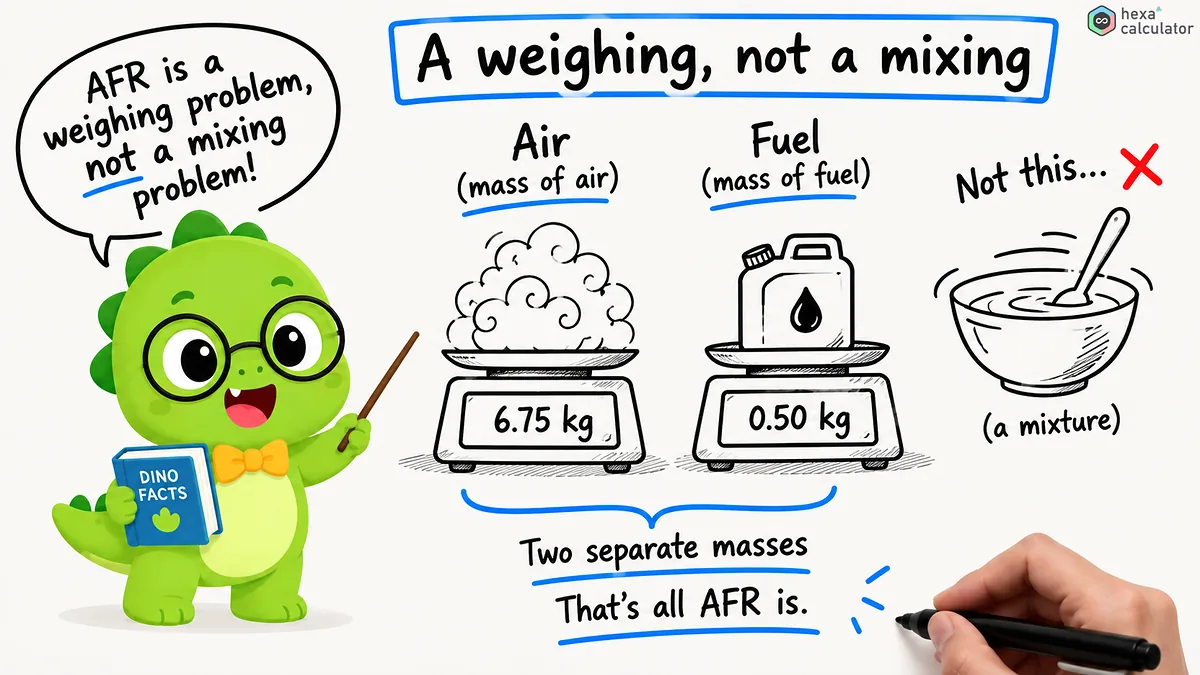
The importance of air-fuel ratio:
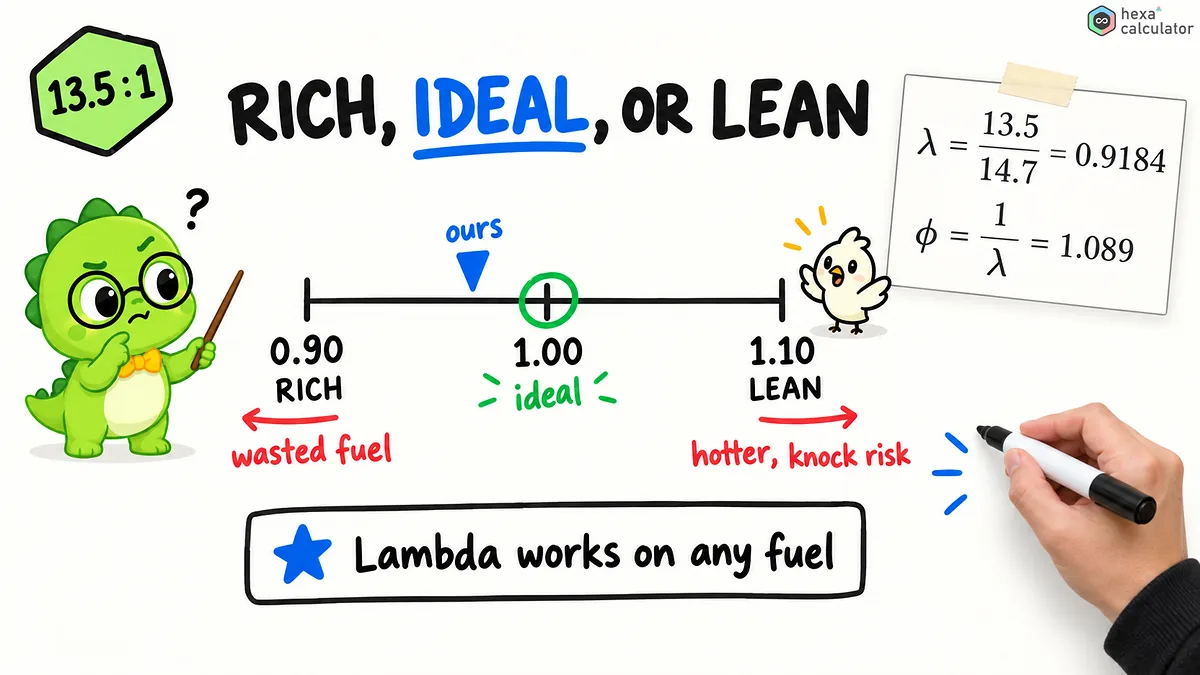
For each fuel there is a certain amount of air required for complete combustion. For petrol the ratio of mass of air to mass of fuel is about 14.7 which is expressed as 14.7:1. This reaction using only this amount of air is called stoichiometric combustion since both oxygen and fuel are completely consumed. If less air is supplied to the engine then the mixture is rich, if more air is supplied it is lean.
Since this ratio is a mass ratio and not a volume ratio, the same units must be used for both air and fuel. If the air is measured in grams, then the fuel must also be measured in grams. As it is a ratio of like units, the AFR itself has no unit. The value 12.5 always means the mass of air 12.5 divided by the mass of fuel 1.
Lambda and stoichiometric ratio:
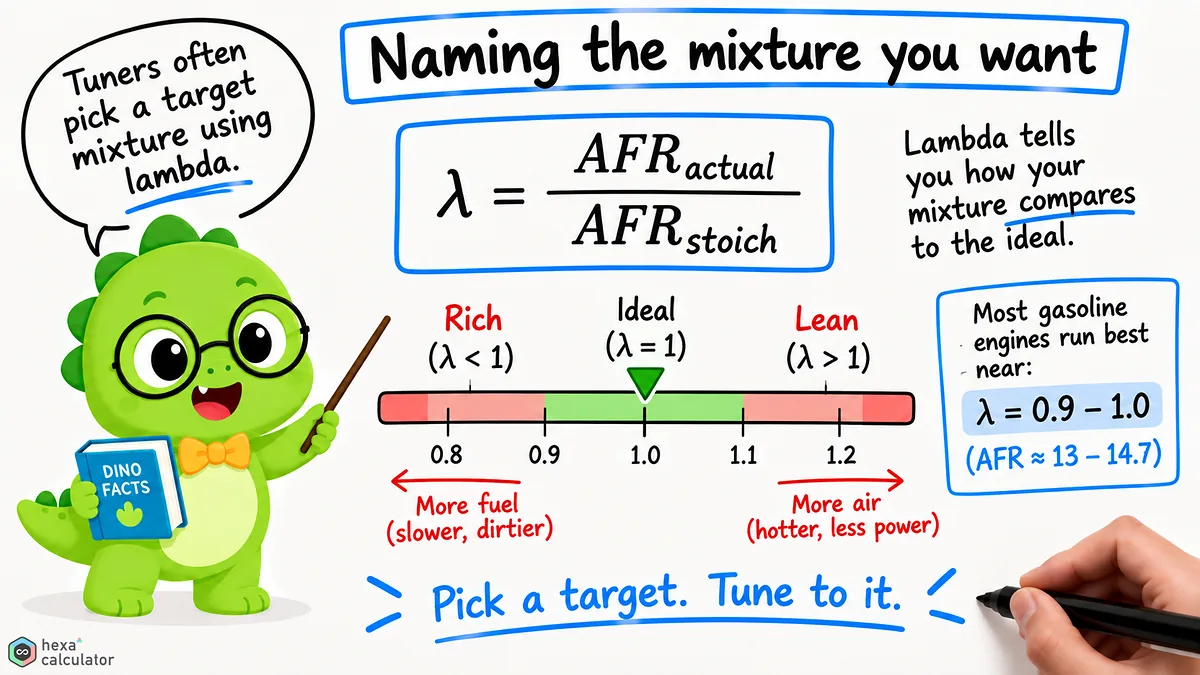
Experts rarely speak of the actual AFR directly as the ideal value varies with fuel. Instead Lambda is used to compare the actual AFR to the stoichiometric AFR for the fuel in the tank. Regardless of what fuel is being used, a lambda of 1.0 indicates an ideal mixture. A value below 1.0 means a rich mixture while a value above 1.0 indicates a lean mixture. Thus Lambda is a way to represent a mixture independent of the fuel and this is why wide band oxygen sensors directly measure this value.
The stoichiometric ratio is represented by the Greek letter φ and is the inverse of λ. If φ exceeds a value of 1.0, then the mixture is rich; if it falls below 1.0, then it is lean. The values of both quantities therefore give the same information but in opposite directions. Air excess is calculated from λ. A value of λ equal to 1.10 means that there is about a 10 percent excess of air over what is actually required for the fuel mixture.
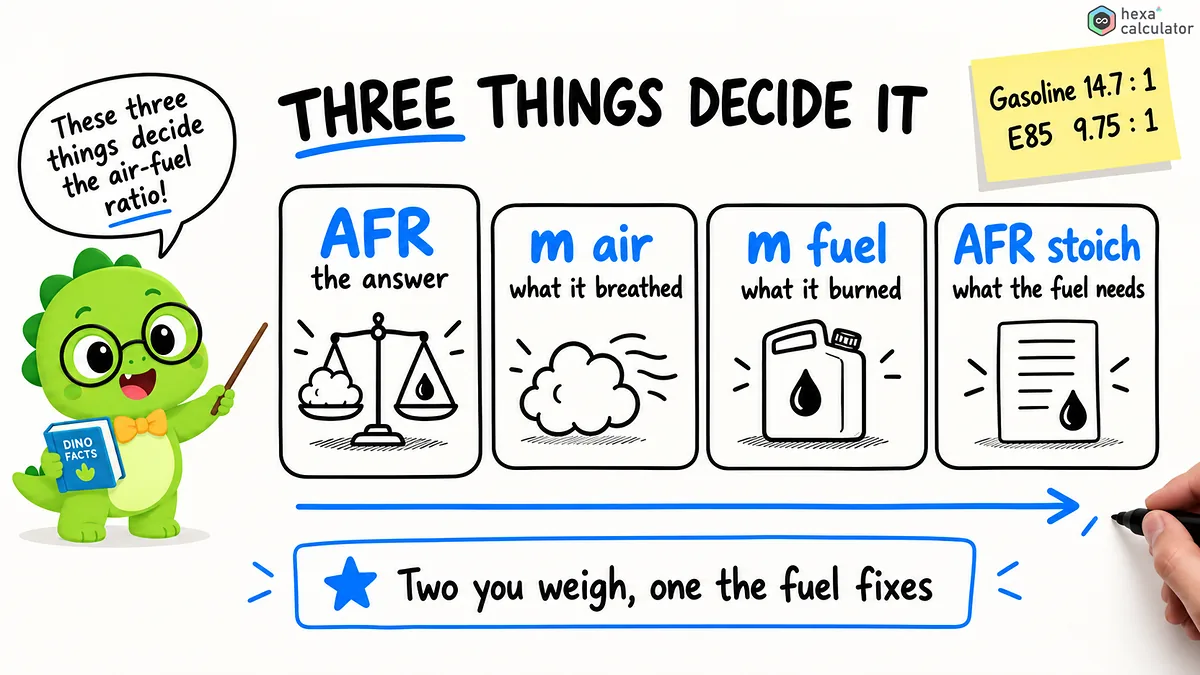
Here's how to use this calculator:
First select the fuel and let the tool set the stoichiometric reference values. Then enter the required value for air mass, fuel mass or AFR, and the tool will calculate the remaining values. If you only want to check the datasheets of the bench or the readings from your instruments, simply enter the value for AFR to retrieve λ and the mixture rating. By activating the "target mixture" option, you can also calculate the values backwards. Enter the desired value for λ and the tool will return the corresponding AFR value and the corresponding fuel mass.
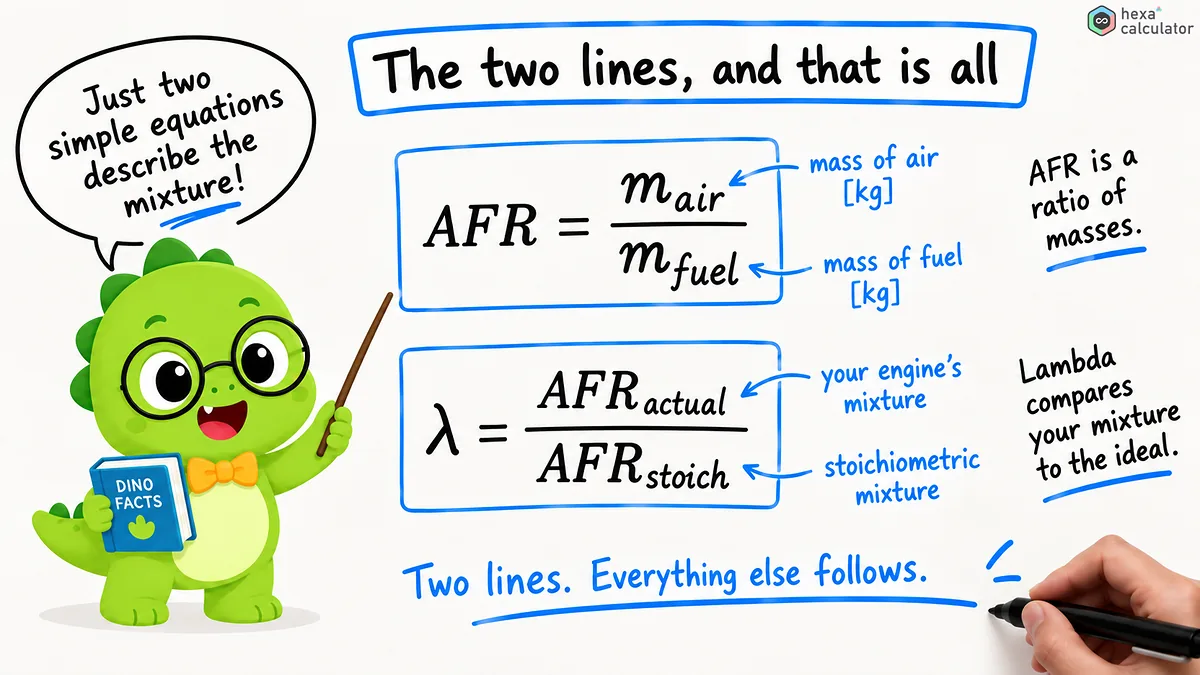
Formula:
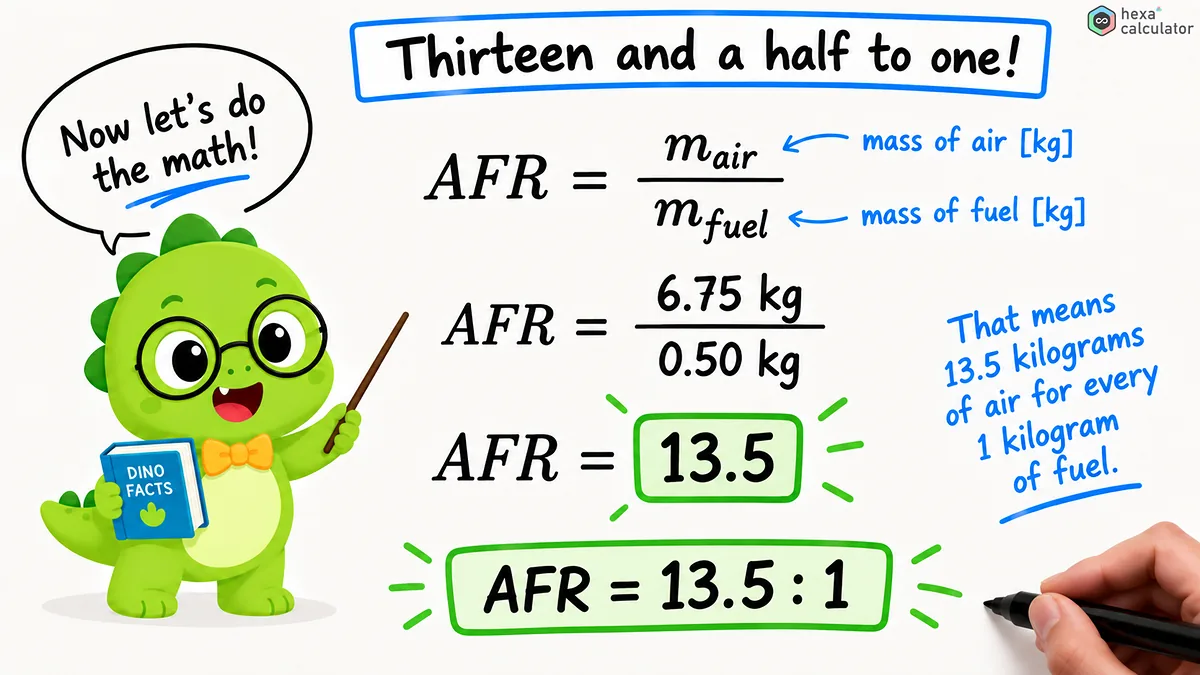
The basic relationship is very simple: AFR is the quotient of air mass and fuel mass.
λ is the quotient of the actual ratio and the stoichiometric ratio of the fuel, where φ is the inverse.
Suppose a petrol engine is running at an actual air-fuel ratio (AFR) of 13.5:1. As the stoichiometric ratio for petrol is 14.7:1, lambda would be approximately equal to 13.5 divided by 14.7, which equals about 0.92. This value is less than 1.0, meaning that the mixture is around 8% too rich. This is a setting often used when an engine is being run at its maximum power output. The deviation from stoichiometric is expressed as a percentage and based on the difference of lambda.
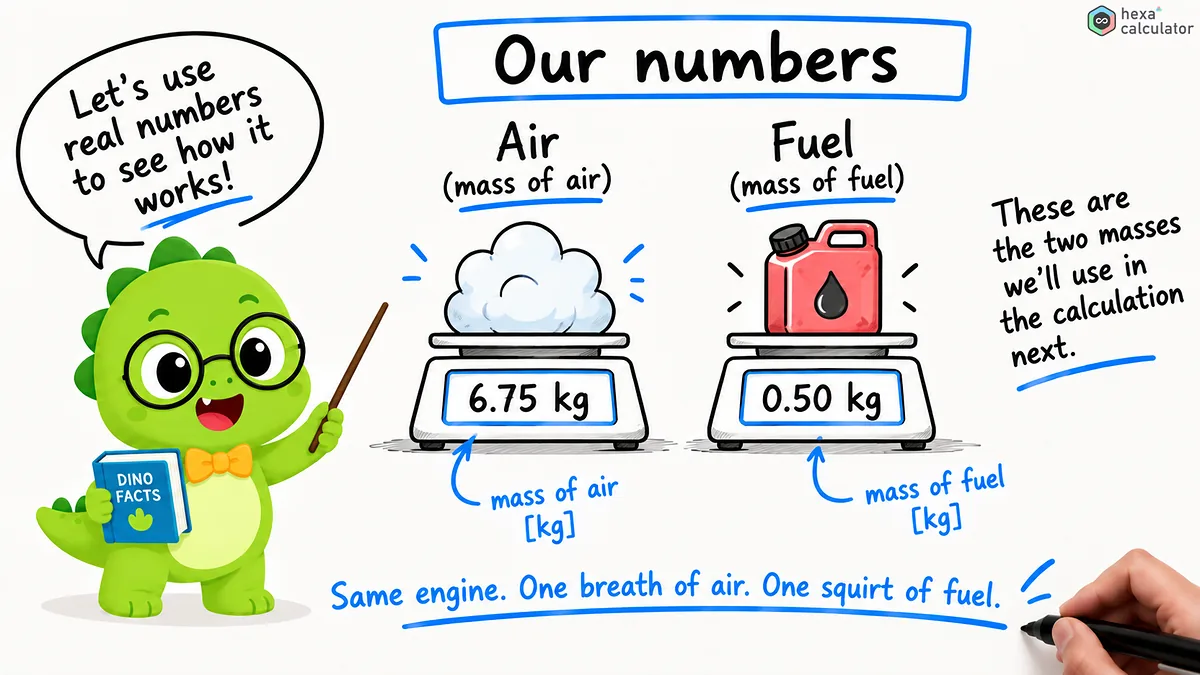
The calculation results in the following AFR for the respective mass of Air and Fuel.
Stoichiometric ratios for various fuels
Since each fuel has a different hydrogen to carbon ratio, there is an ideal value for each one. Hydrogen requires significantly more air per gram than gasoline, while alcohols such as methanol and ethanol require considerably less air. The following table shows the values used in this tool.
Fuel | Stoichiometric AFR | Family |
|---|---|---|
Methanol (CH3OH) | 6.47 : 1 | Alcohol |
Ethanol E85 | 9.75 : 1 | Alcohol blend |
Gasoline (C8H18) | 14.70 : 1 | Petroleum |
Diesel (C12H23) | 14.50 : 1 | Petroleum |
Propane (C3H8) | 15.67 : 1 | Hydrocarbon |
Methane (CH4) | 17.19 : 1 | Hydrocarbon |
Hydrogen (H2) | 34.30 : 1 | Gas |
Why Air-Fuel Ratio is Important
In a petrol engine the mixture affects power output, fuel consumption and emissions. When running at near stoichiometric ratio the catalytic converter can clean up exhaust gases and fuel consumption is low. At high load the management systems will increase the amount of fuel being injected and lower lambda to about 0.85 to 0.90. This is because excess fuel mixture cools down combustion and prevents knock. If the mixture becomes too lean then the engine runs hotter and there is a risk of component damage. Therefore, lean mixture fault codes should be taken seriously.
The same principle applies to diesel engines, gas turbines, furnaces and laboratory burners. Diesel engines always run with a lean mixture, where lambda is often significantly greater than 1, and both soot and nitrogen oxide emissions are closely related to this value. Regardless of where the fuel and air meet, this ratio determines the completeness and cleanliness of combustion.
Tips for meaningful measurements:
Measure air and fuel in the same units to ensure that the ratio is correct. When reading a wideband sensor, note that it displays the lambda value. Multiply the lambda value by the stoichiometric AFR of the fuel being used to get the actual air excess. Choose a fuel that matches the actual fuel in your tank. Even at the same lambda value, the target AFR values can be significantly different when tuning E85 and gasoline.
Frequently asked questions
What is the ideal air-fuel ratio?
For gasoline, a ratio of 14.7:1 (Lambda 1.0) is chemically ideal and serves as the target value for clean exhaust gases and good fuel consumption. At full load, many engines work with a slightly richer mixture, e.g. 12.5:1 to 13.3:1, in order to ensure safe power delivery. The optimal value depends on the fuel used and the load.
What is the difference between AFR and Lambda?
AFR (Air-Fuel Ratio) is the original mass ratio of air and fuel, and its ideal value varies according to the fuel. Lambda is a value obtained by dividing actual AFR with stoichiometric AFR of each fuel. So if lambda is 1.0 then every fuel is at its optimal value. Lambda is a fuel-independent method to express the same value.
Does the air-fuel ratio change according to fuel?
Yes. Every fuel has its own specific stoichiometric ratio. Gasoline is about 14.7:1, E85 is 9.75:1 and hydrogen is 34.3:1. Be sure to select the correct fuel and make sure your lambda and mixture values use correct reference values.
Which is better, a fat or a lean mixture?
Neither is inherently better; a rich mixture cools the combustion and protects the engine at high power, but wastes fuel and increases unburned emissions. A lean mixture can save fuel, but leads to higher operating temperatures, and an excessively lean mixture can cause knock or damage. The stoichiometric ratio is the balanced point for normal driving operation.
How do you convert a lambda value to an AFR?
The Lambda value is multiplied by the stoichiometric air excess (AFR). If a wideband sensor shows a lambda of 0.90 when running on petrol, then the AFR ratio will be approximately 13.2:1, which is 0.90 multiplied by 14.7. This calculator allows for two-way conversion.
Related calculators
Disclaimer: This calculator is provided for general informational and educational purposes only. Our calculators are under active development, and results may be inaccurate, incomplete, or unsuitable for your situation. Always verify the figures independently and seek advice from a qualified professional before relying on them. We make no warranties and accept no liability for any loss or decision arising from use of this tool.
References
- x-engineer.org: Air-fuel ratio, lambda and the combustion process
Engineering walkthrough of AFR, lambda, and the equivalence ratio.
- Wikipedia: Air-fuel ratio
Definitions, stoichiometric values by fuel, and lambda.