Aerodynamic Drag Calculator
Calculate drag force with the drag equation. Solve for force, speed, area, density, or drag coefficient, and get dynamic pressure, power, and terminal velocity.
https://hexacalculator.com/calculators/physics/engineering/aerodynamic-drag-calculator
Physics
Engineering
Aerodynamic Drag Calculator
Calculate drag force with the drag equation. Solve for force, speed, area, density, or drag coefficient, and get dynamic pressure, power, and terminal velocity.
Aerodynamic Drag Calculator
Find terminal velocity
Add an object mass to find the steady falling speed where drag balances gravity.
Drag force
- Dynamic pressure
- Pa
- Drag area (Cd x A)
- m²
- Power to overcome drag
- kW
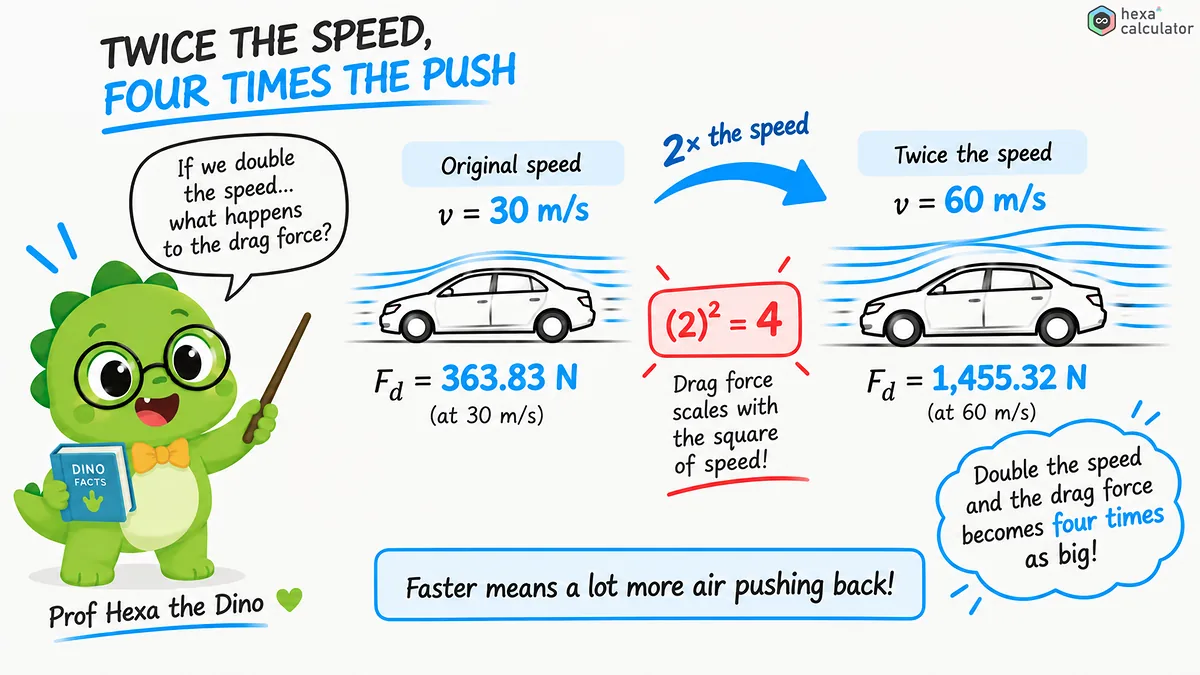
Drag rises with the square of speed. Double the velocity and the drag force roughly quadruples, so easing off the speed is the simplest way to cut drag.
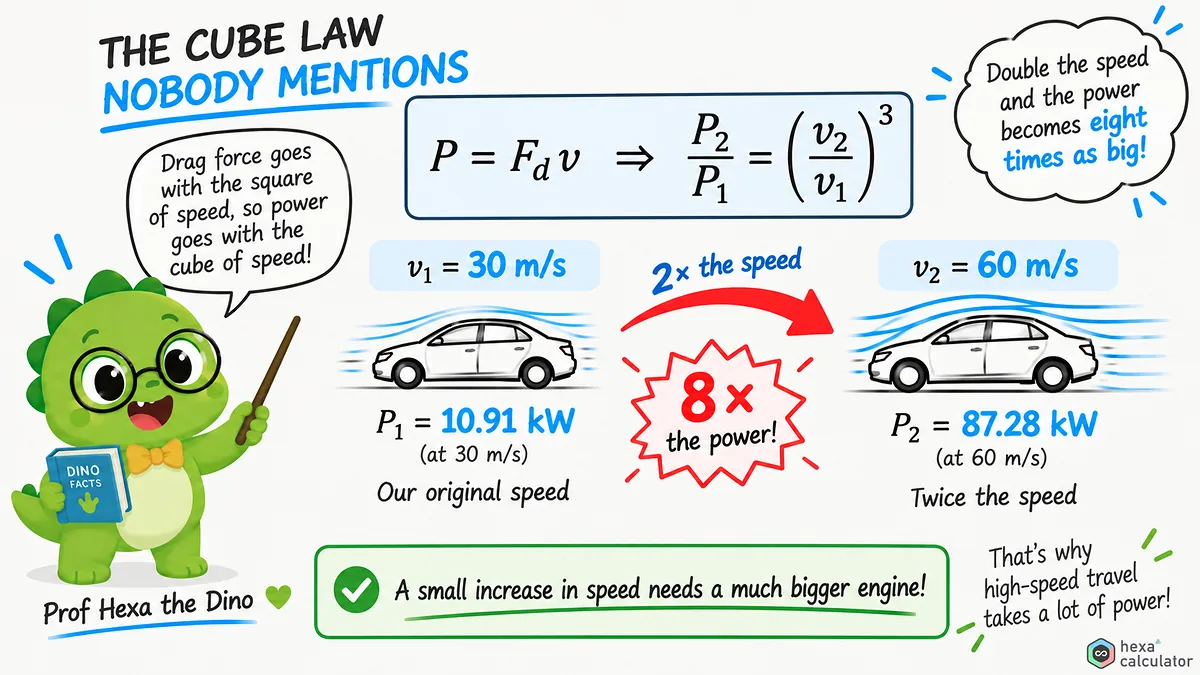
Power to push through the air grows with the cube of speed. Going twice as fast needs about eight times the power, which is why top speed is so costly.
Was this calculator helpful?
It takes one click and shapes what we fix next.
Add as preferred on GoogleShow drag force vs speed
Plot how the drag force grows as speed rises.
Show power vs speed
Plot the power needed to push through the air at each speed.
Show the speed impact table
Compare drag and power at several speeds around your input.
Velocity (m/s) | Drag force (N) | Power (W) | Change vs current |
|---|---|---|---|
| 15 | 90.96 | 1,364.34 | -75.0% |
| 22.5 | 204.65 | 4,604.66 | -43.7% |
| 30 | 363.83 | 10,914.75 | +0.0% |
| 37.5 | 568.48 | 21,317.87 | +56.3% |
| 45 | 818.61 | 36,837.28 | +125.0% |
| 60 | 1,455.3 | 87,318 | +300.0% |
Drag is a force that acts on any object moving through the air and acts in the opposite direction to its motion. This calculator computes this force using the drag equation given the density of the air, velocity, projected area, and a drag coefficient which describes the shape of the object. If one of the five input fields is left blank, then the calculator will switch into mode for calculating that value. Thus, it can be used to find either the drag force, the drag coefficient from wind tunnel measurements, or the speed at which a known drag force occurs.
What is air resistance?
When an object is moving through the air it experiences resistance to its motion from the air. This resistance is called drag. The amount of drag experienced by an object depends on four factors; the density of the air, the speed of the object, the projected area of the object and the degree of streamlining of its shape. Speed has the greatest effect as it appears squared in the formula so even a small increase in speed leads to a large increase in drag which is why fuel consumption and power requirements rapidly increase at high speeds.
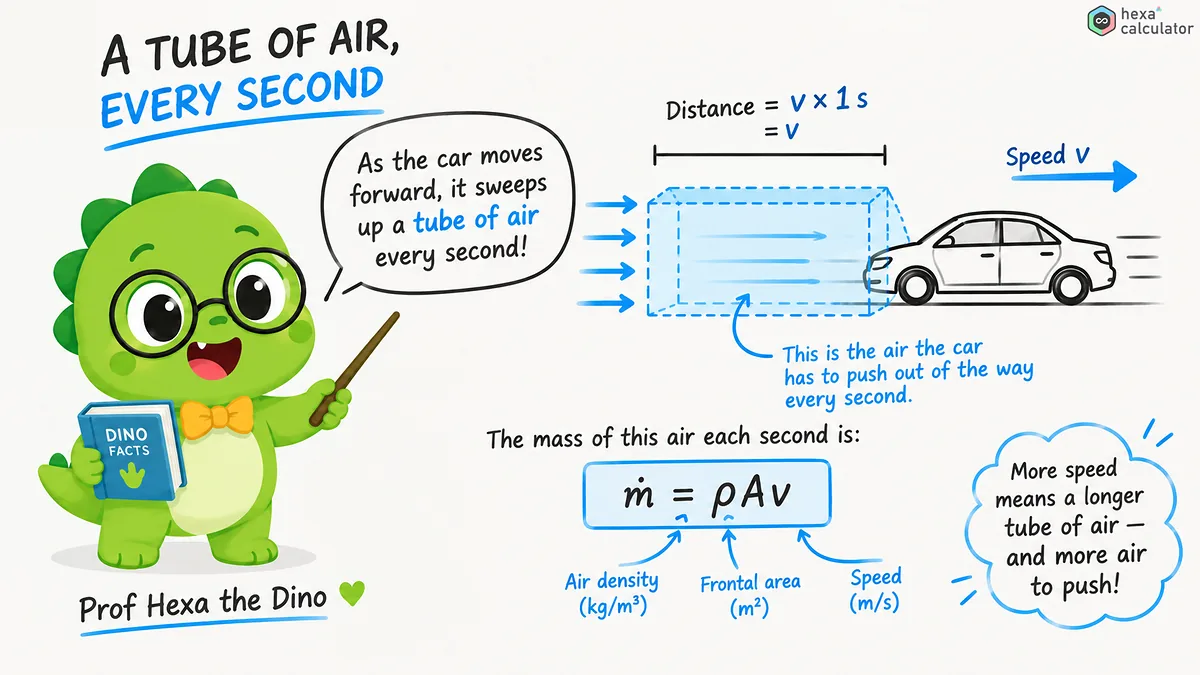
How to use this calculator:
This calculator will return the air resistance given the density of the air, velocity, reference area and drag coefficient. To find a value, leave blank the field for which you want to solve and enter values for the other four fields. This is useful for common applications such as calculating the air resistance on a car or wing, finding the drag coefficient from measured values, or determining what speed is required to produce a certain amount of air resistance. If you enable the "Terminal Velocity" option and enter the mass of the object, it will also calculate the terminal velocity at which a falling object eventually stabilizes.
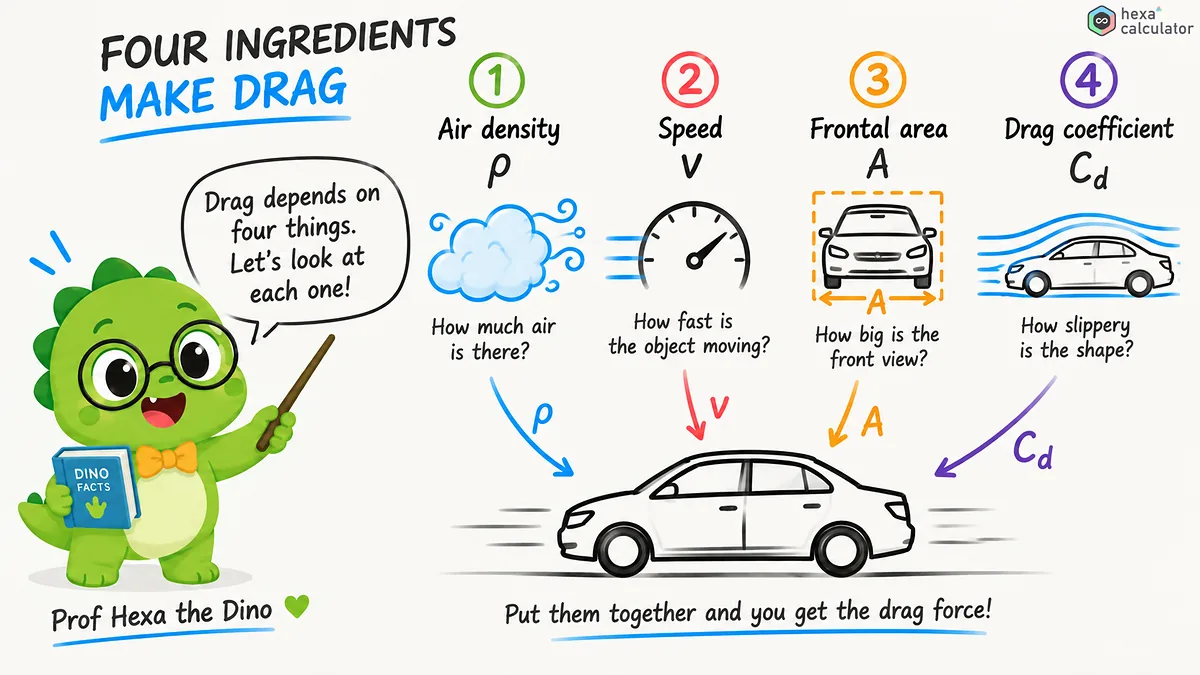
Formula for air resistance
The air resistance is calculated with the standard formula for air resistance.
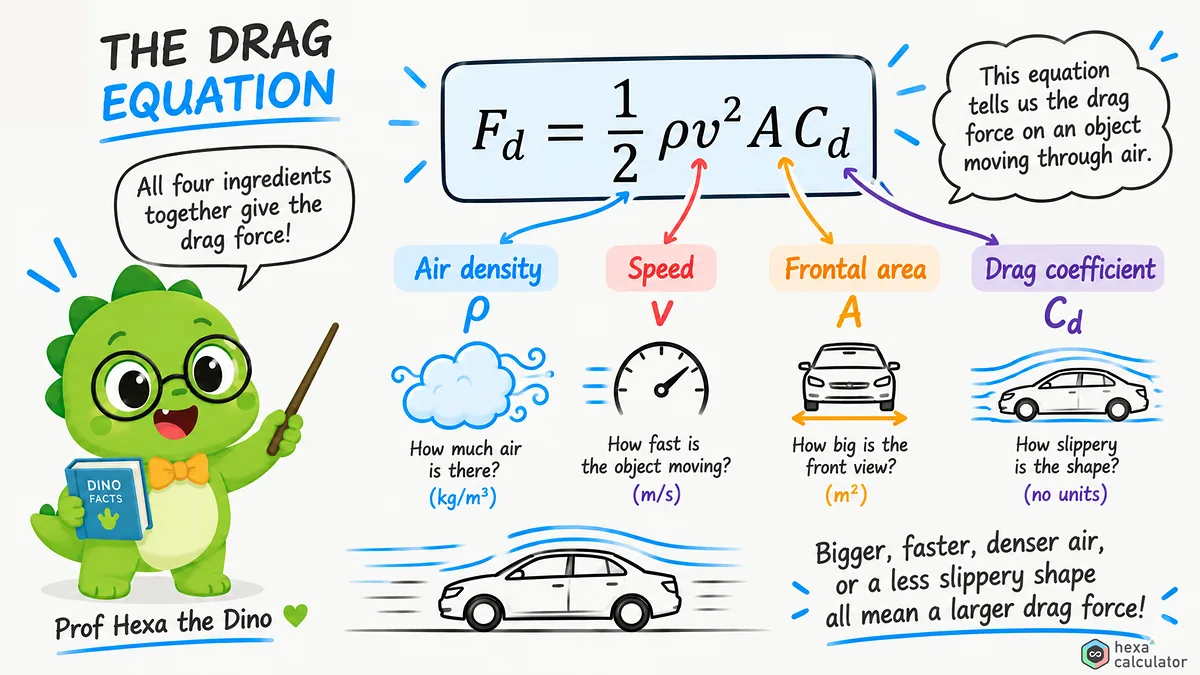
where is the air density, is the speed, is the reference area and is the drag coefficient.
Let's say a particular car is traveling through the air at sea level with a speed of 30 m/s (roughly 108 km/h), has a frontal area of 2.2 m, and a drag coefficient of 0.30.
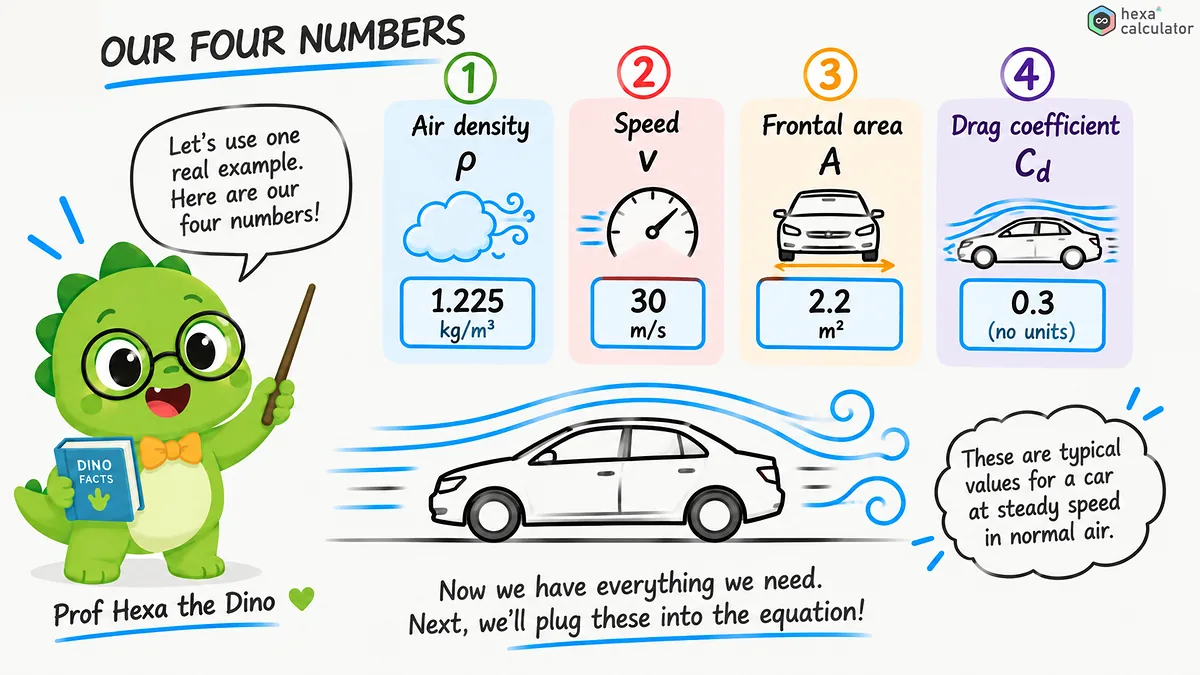
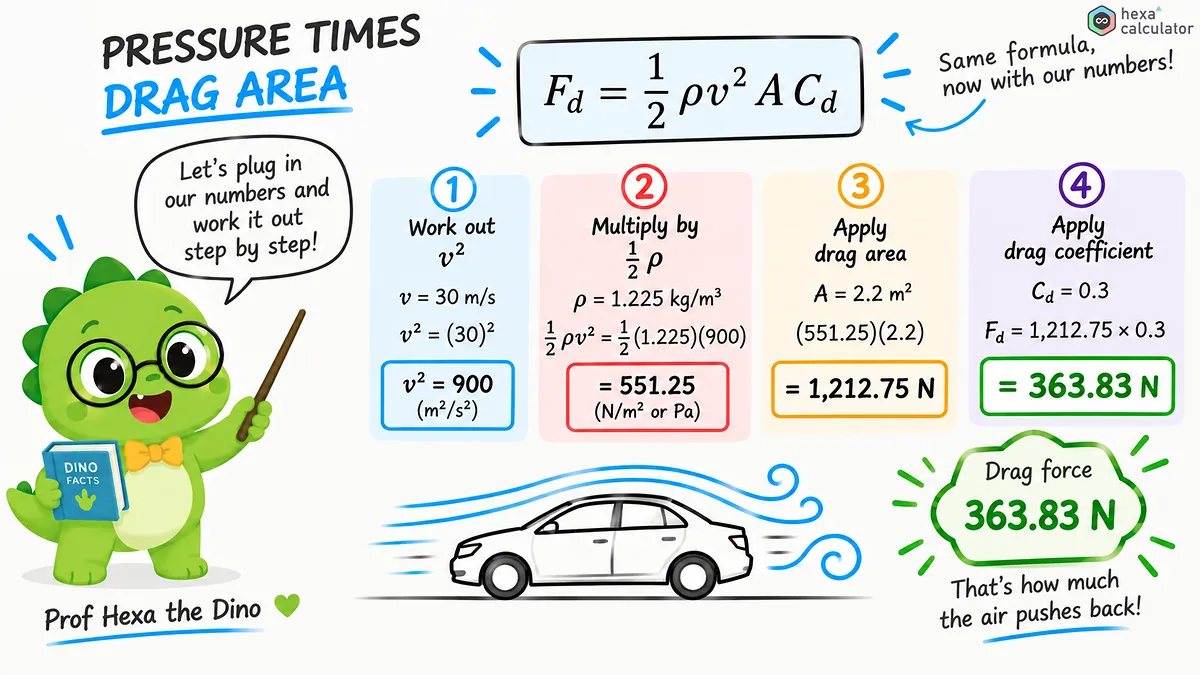
To overcome an air resistance of 363.8 N at a speed of 30 m/s, approximately 10.9 kW or about 15 HP is required. The following table shows the individual symbols and their values for this example.
Symbol | Meaning | Example |
|---|---|---|
Drag force | 363.8 N | |
Air density | 1.225 | |
Velocity | 30 m/s | |
Reference area | 2.2 | |
Drag coefficient | 0.30 |
Formula change to calculate any values:
Since the formula for drag is simply a product of several quantities, it can be easily manipulated. A calculation tool will use one of the following forms and select the appropriate form based on what fields are filled in.
The first form is used to convert an air resistance measured in a wind tunnel into a drag coefficient. The second form shows the speed at which an object must move to produce a given force.
Also if you notice, if you double the speed the drag force increases four times, due to the square component of the velocity in the formula.
And, since Power is equal to Force times velocity, the Power increases 8 times if velocity doubles, basically following a cube law.
Resistance coefficient
The drag coefficient is a dimensionless number that describes the effect of an object's shape on air resistance. Smooth, streamlined objects have low values and move through the air easily. Blunt or flat shapes have higher values. Although it can vary slightly with flow conditions, for everyday speeds one value is usually sufficient. Typical values to use as a starting point are given below.
Shape | Approximate Cd |
|---|---|
Streamlined body or airfoil | 0.04 |
Bullet | 0.30 |
Modern car | 0.25 to 0.30 |
Sphere | 0.47 |
Long cylinder (side on) | 0.82 |
Upright cyclist | 0.90 |
Cube, flat face forward | 1.05 |
Skydiver, belly to earth | 1.0 to 1.3 |
Flat plate, face on | 1.28 |
Open parachute | 1.3 to 1.5 |
Air density used
Air density decreases with altitude and also changes depending on temperature and humidity, so the appropriate value depends on the specific conditions. Sea level standard atmosphere is usually a good starting point.
Condition | Air density |
|---|---|
Sea level, 15 C | 1.225 |
20 C, 101.325 kPa | 1.204 |
0 C, 100 kPa | 1.275 |
This formula is not only for air; it can be used with the density of any fluid, and the calculator will give you the drag force on an object in that medium. For example, the density of water surrounding a swimmer or boat is about 1000 kg/m.
Final speed
A falling object accelerates until the air resistance is large enough to balance out gravity. At that point, the net force is zero and the speed remains constant. If you set the air resistance equal to gravity and solve for velocity, you get terminal velocity.
Here is the mass and is the acceleration of gravity. The option "Terminal velocity" calculates this value. A skydiver with a mass of 80 kg falling in belly position, having an air resistance coefficient of about 1.0 and a projected front area of approximately 0.7 m² has a terminal velocity of about 43 m/s which is about 155 km/h.
Applications of air resistance
In the design of cars, planes, rockets and trains, air resistance affects the whole construction concept. The lower the air resistance is, the less fuel is consumed and the higher the speed is. In cycling, swimming, skiing and motor sports as well, air resistance has an impact on the equipment design, since even small differences in shape can affect actual performance. Engineers also assess wind loads on buildings, bridges and towers to ensure that structures withstand strong gusts.
Tips for a good estimate
Make sure the reference area matches the drag coefficient you are using. Published coefficients usually refer to a particular area, often the projected area. Use an air density appropriate for altitude and weather, not always sea level values. The results should be considered rough estimates. Actual drag also depends on surface roughness, flow field separation, and interactions between components, but a single coefficient cannot fully account for these factors.
Frequently asked questions
What is the resistance equation?
The drag equation is: Fd = 0.5*rho*v squared*A*Cd. In this equation half the air density is multiplied by the square of the velocity, reference area and drag coefficient to calculate the drag force acting on a moving object.
How is the drag coefficient determined?
The resistance equation is given by Cd = 2*Fd/(rho*v^2 * A). If you enter the measured drag, air density, velocity and area and leave the drag coefficient blank, this tool will calculate it for you. Alternatively, you can use published values for objects of similar shape as a starting point.
Why does resistance increase so quickly with increasing speed?
The speed appears as the square in the formula, therefore air resistance increases proportionally to the square of the speed. When the speed doubles, the air resistance increases approximately by a factor of four. The power required to overcome the air resistance is proportional to the third power of the speed and thus rises approximately by a factor of eight.
What reference surface should be used?
Use the reference area that the published drag coefficient is based on. This will usually be either the front projected area or the cross-sectional area exposed to the airflow. For an automobile, the front projected area is used, while for a wing it's usually the planform area. The area must match the one used in the coefficient.
What is its final velocity?
Terminal velocity is the steady speed that a falling object reaches when air resistance and gravity are balanced. It can be calculated as the square root of 2 m g divided by the product of rho, A, and Cd. If you enable the terminal velocity option and enter the mass, it will be able to calculate it.
Related calculators






Disclaimer: This calculator is provided for general informational and educational purposes only. Our calculators are under active development, and results may be inaccurate, incomplete, or unsuitable for your situation. Always verify the figures independently and seek advice from a qualified professional before relying on them. We make no warranties and accept no liability for any loss or decision arising from use of this tool.
References
- NASA Glenn Research Center: The Drag Equation
NASA explainer on the drag equation and each of its terms.
- Wikipedia: Drag coefficient
Reference drag coefficients for common shapes.