Activation Energy Calculator
Solve the Arrhenius equation for activation energy, rate coefficient, frequency factor, or temperature. Includes the two-point method and an Arrhenius plot.
https://hexacalculator.com/calculators/physics/thermodynamics/activation-energy-calculator
Physics
Thermodynamics
Activation Energy Calculator
Solve the Arrhenius equation for activation energy, rate coefficient, frequency factor, or temperature. Includes the two-point method and an Arrhenius plot.
Activation Energy Calculator
Fill in any three of temperature, rate coefficient, frequency factor, and activation energy. The calculator solves for the fourth and fills it in place.
I have a second rate at a second temperature
Find the activation energy straight from two measurements, no frequency factor needed.
Please input values into the fields
Was this calculator helpful?
It takes one click and shapes what we fix next.
Add as preferred on GoogleShow the rate-versus-temperature curve
Plot how the rate coefficient climbs as the temperature rises.
Show the Arrhenius plot
Plot ln k against 1/T, the straight line whose slope is minus Ea over R.
Show the temperature table
List the rate coefficient across a spread of temperatures.
Activation energy is the energy barrier that chemical reactions must overcome before they can start. Wood can sit in the air at room temperature but when it burns it releases a large amount of energy. This is because of the activation energy.
This tool allows you to solve the Arrhenius equation for any variable. Enter three of four parameters - temperature, rate constant, frequency factor (also called pre-exponential factor), and activation energy - to calculate the fourth parameter. If you enter a second set of measurements, it will allow you to directly calculate the activation energy from experimental data, similar to what would be done in a chemical reaction laboratory.
What is Activation Energy?
At each transition from reactants to products, a process must go through a high-energy structure called the transition state. The activation energy is represented by Ea and indicates the height of the energy barrier from the initial energy level of the reactants to the top of this barrier.
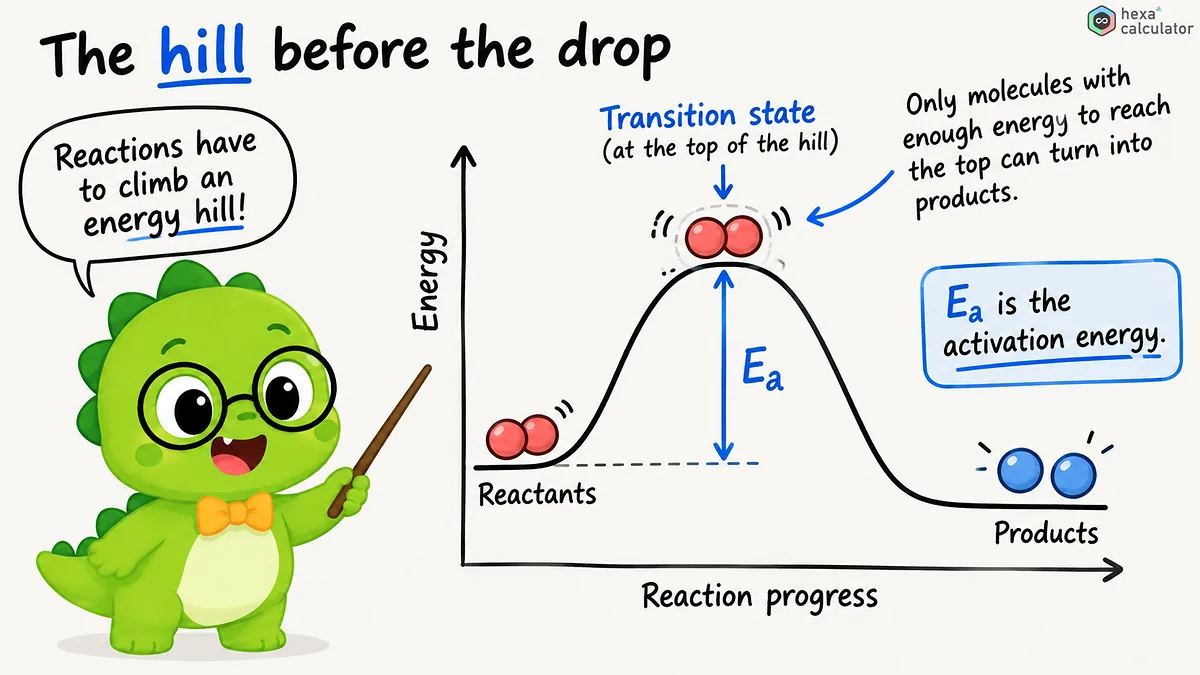
Molecules whose collision energy is below this barrier will simply bounce off each other and not react. Only molecules that are moving fast enough to overcome the energy barrier can proceed with the reaction. This is why reactions happen faster when the temperature is increased, as more molecules are able to overcome the energy barrier.
The Arrhenius equation.
Svante Arrhenius formulated a simple equation that related reaction rate to temperature and activation energy.
In this case, k is the rate constant, A is the frequency factor and R is the gas constant, which has a value of 8.314 joules/(mole·kelvin). T is the absolute temperature in kelvins.
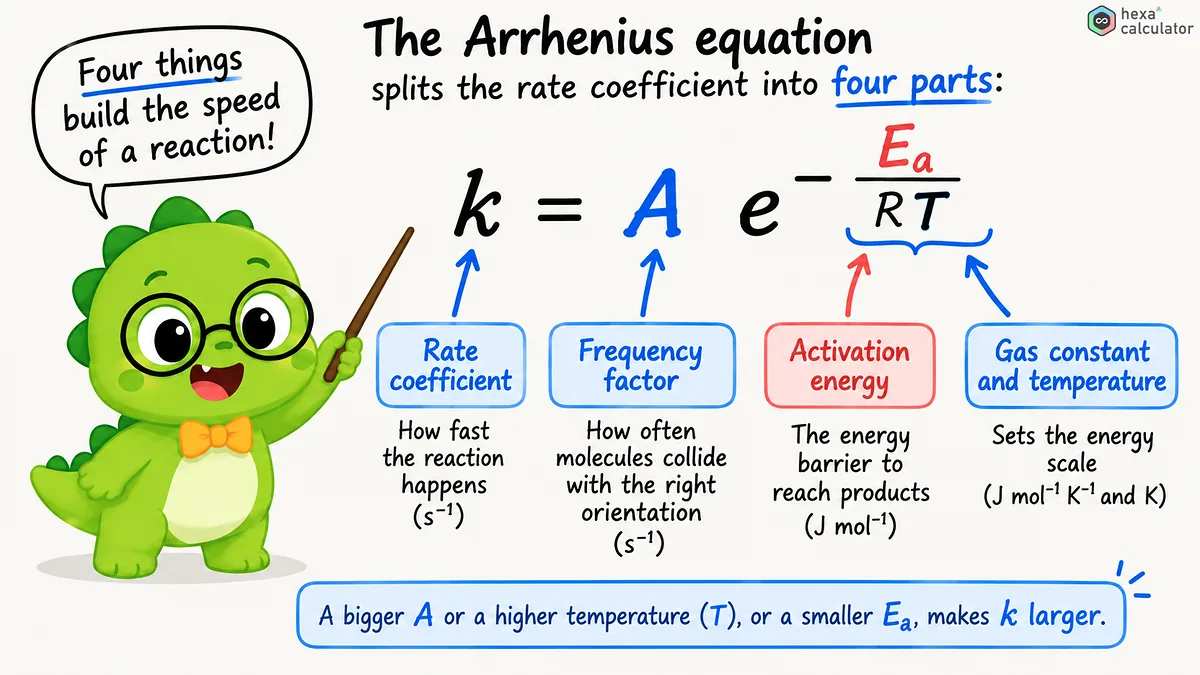
By using the natural logarithm, the equation can be converted into a linear form that is easier to understand.
The whole equation is determined by two main properties: the temperature is in the exponent, which means that an increase in temperature leads to a rapid increase in rate; and the term for activation energy is negative, meaning that a higher barrier will lead to a slower reaction.
How to use this calculator:
Enter any three values into the four input fields and leave the field blank whose value you want to calculate. The calculation tool will then calculate the value of the free field and display it. You can thus calculate the activation energy, the rate constant k, the frequency factor A or the temperature.
The temperature can be entered in Celsius, Fahrenheit or Kelvin and will automatically be converted to Kelvin before the calculation. The rate constant and frequency factor use the same units. For a first order reaction the common unit is "per second". The activation energy can be entered in Joules/Mole, Kilojoules/Mole, Calories/Mole or Kilocalories/Mole.
If you have already measured the rate at two different temperatures please enable the second measurement option. This method allows you to determine the activation energy without knowing the frequency factor.
Example calculation:
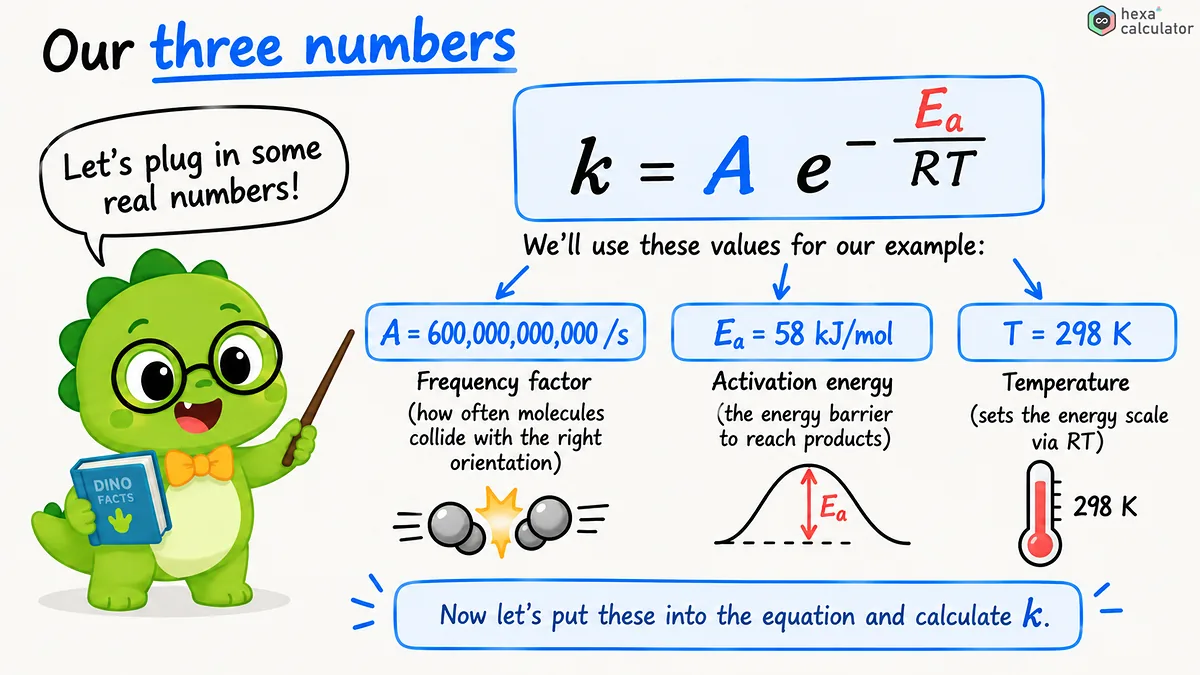
Suppose for a particular reaction, the frequency factor is about 6.0 times 10 to the eleventh per second at 298 K and the activation energy is 58 kilojoules per mole. Let's put those values into the formula.
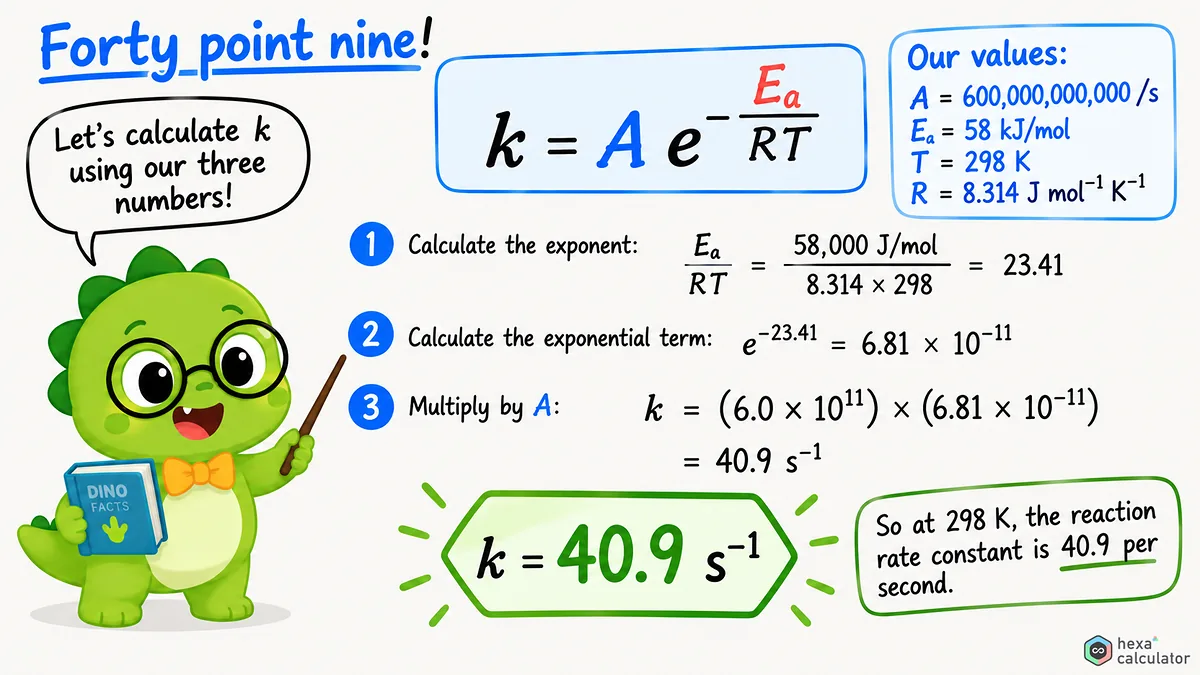
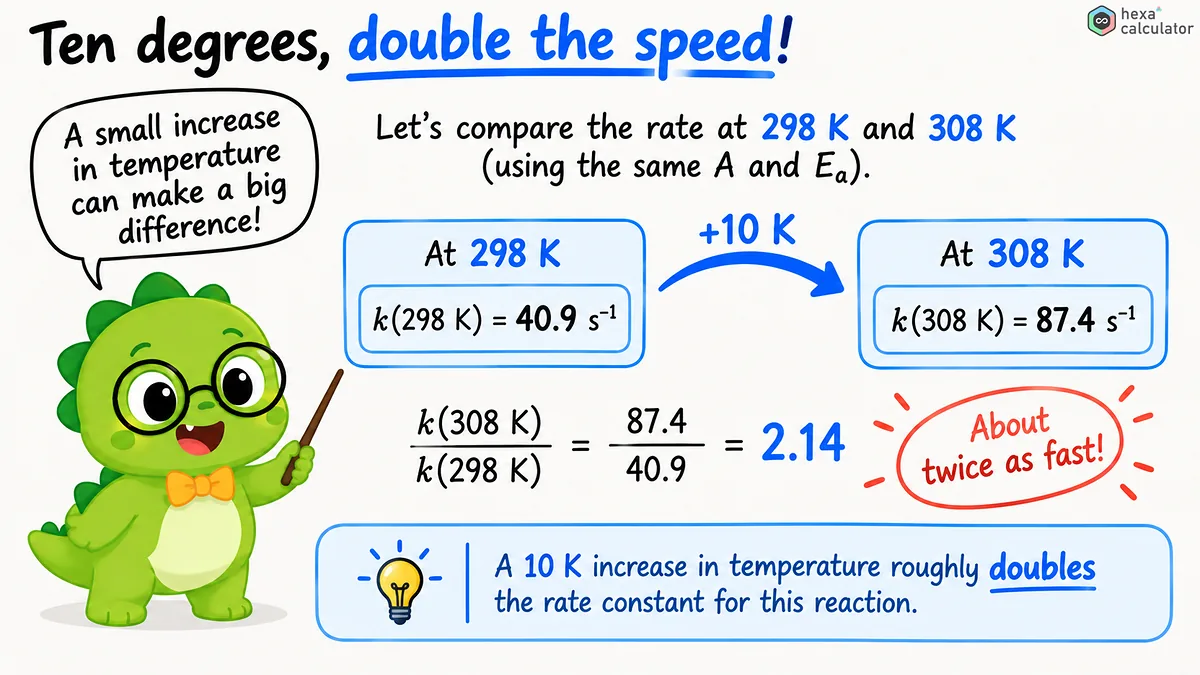
If the temperature is increased by ten degrees to 308 K then k increases to about 87 per second. The energy barrier remains the same and the reaction is the same but by increasing the temperature by just ten degrees the rate has more than doubled. This high sensitivity to temperature is why refrigeration helps food last longer, and also why a thermal runaway in a reactor can be very dangerous.
Determination of activation energy from two measured values:
In practice the frequency factor is usually not known in advance. The usual method in a lab is to measure the rate constants at two different temperatures and compare the results of the two sets. Subtracting the logarithmic values of the two data points eliminates A completely.
In summary, activation energy can be calculated.
For example, the rate constant of a reaction increases by 1.0*10^-3 per second (at a temperature of 300K) to 2.0*10^-3 per second (at a temperature of 310 K), which means that it has doubled. This results in an activation energy of about 54 kJ/mol. The frequency factor is not required for this calculation.
Arrhenius plot
The two-point method can also be applied to multiple data sets. If a graph is plotted with 1/T on the x-axis and ln k on the y-axis, all points will lie on a straight line. The slope of this line is negative and equal to Ea/R, while the y-intercept is ln A.
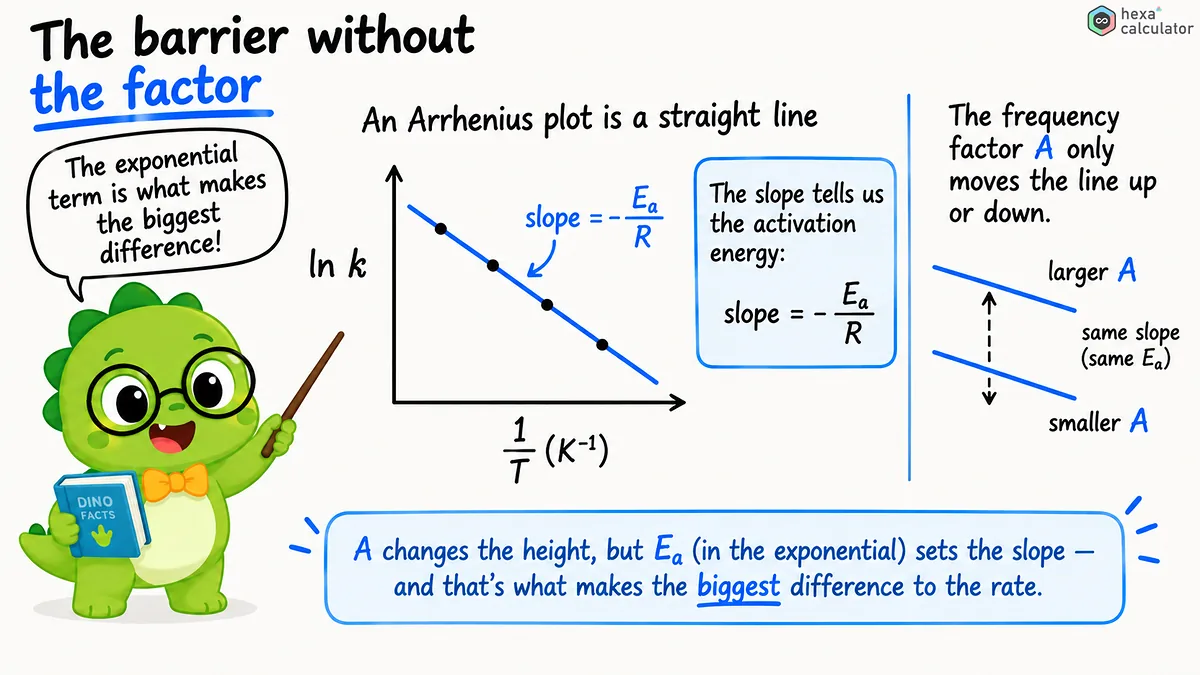
This is one of the most commonly used graphs in chemistry. The steeper the downward slope, the higher the activation energy. Most published values for activation energies are determined from the slope of this line. This graph will be generated based on your input data in the "Analysis" section below.
How to Interpret Results.
The activation energy for most common reactions is in the range of about 50 to 200 kJ/mol. Values below about 20 kJ/mol usually indicate a diffusion-limited or barrier-free reaction; in this case, the rate of reaction is not determined by the height of the energy hill but rather by how fast molecules bump into each other.
The frequency factors for simple reactions are typically in the range of 10^8 to 10^13 per second. The calculation tools also show the thermal energy RT and the ratio Ea/RT. The latter indicates by what factor the energy barrier is higher than the available thermal energy.
For reactions with a frequency factor A close to 6.0 x 10^11 per second and an activation energy of 58 kJ/mol the rate constant increases strongly with temperature as shown in the following table.
Temperature | Rate constant k (per second) | Relative to 298 K |
|---|---|---|
288 K (15 C) | 18.1 | 0.44x |
298 K (25 C) | 40.9 | 1.00x |
308 K (35 C) | 87.4 | 2.14x |
318 K (45 C) | 178.1 | 4.36x |
Symbol overview:
Each symbol in the Arrhenius equation has a specific meaning. The following table shows each symbol along with typical values to aid understanding of the quantities involved.
Symbol | Meaning | Typical value |
|---|---|---|
k | Rate coefficient | varies, per second |
A | Frequency factor | ten to the 8th to 13th per second |
Ea | Activation energy | 50 to 200 kJ/mol |
R | Gas constant | 8.314 J/(mol K) |
T | Absolute temperature | in kelvin |
Catalysts, enzymes, negative activation energy.
Catalysts speed up reactions by providing a lower energy pathway for the reaction to take place and lowering the activation energy. Enzymes are biochemical catalysts that perform the same function in living cells. They often dramatically decrease the energy barrier without being consumed themselves.
Some multi-step or non-reactive processes can even have a negative activation energy. In this case the overall rate of reaction decreases with increasing temperature. This may seem counter-intuitive at first, but is an actually observed phenomenon. This tool can display results with negative values.
Applications of the Arrhenius equation:
The applications of this mathematical relationship are not limited to the chemical laboratory. In assessing the shelf life of pharmaceuticals they are degraded at high temperatures in an accelerated fashion and then the Arrhenius relationship is used to extrapolate the result to lower temperatures. Food scientists use the same principle in reverse to develop chilling conditions.
Battery degradation, tire longevity, semiconductor reliability tests and some climate models all rely on the same temperature dependent relationship.
Frequently asked questions
Why do we need to use the Kelvin scale for temperature?
The Arrhenius equation uses absolute temperatures. Therefore, a value of T=0 must represent the state with no thermal energy, which only occurs at absolute zero. Because the Celsius and Fahrenheit scales have different zeroes, direct substitution would give incorrect results. You can enter values in either Celsius or Fahrenheit here, and the calculator will convert them to Kelvin before performing the calculation.
Are the units of rate constant important?
When calculating the activation energy from two sets of rate measurements, the units cancel out in the ratio k2/k1. So it does not matter what units are used as long as they are consistent between both sets. When a new rate constant is predicted, the result must have the same units as the original rate constant.
Can activation energy be negative?
In a few cases this is possible. Some multi-step or non-reactive processes have negative activation energies, meaning that the overall rate constant decreases with increasing temperature. This phenomenon is not common but the mathematical relationship still holds and this tool does not prevent negative results.
What is frequency factor A?
A is also called the pre-exponential factor and gives a rough idea of how often molecules collide effectively with the correct orientation. It determines the rate at which a reaction can take place, assuming that all collisions have enough energy. For simple reactions this value typically lies between 10^8 and 10^13 per second.
How to determine activation energy from a graph?
Make a graph with the reciprocal of absolute temperature (1/T) on the horizontal axis and the natural logarithm of the rate constant on the vertical axis. Each point will form a straight line, which has a negative slope equal to -Ea/R. So multiply the slope by the negative value of R to get the activation energy. This tool makes an Arrhenius plot in the "Analysis" section.
Do catalysts and enzymes change activation energy?
Yes they do. Catalysts open up a lower energy pathway for the reaction to take place, lowering the activation energy and speeding up the reaction without being used up themselves. Enzymes are catalysts in the human body and can significantly lower the energy barrier.
Related calculators
Disclaimer: This calculator is provided for general informational and educational purposes only. Our calculators are under active development, and results may be inaccurate, incomplete, or unsuitable for your situation. Always verify the figures independently and seek advice from a qualified professional before relying on them. We make no warranties and accept no liability for any loss or decision arising from use of this tool.
References
- Wikipedia: Arrhenius equation
Definition, the two-point form, and the Arrhenius plot.
- LibreTexts: The Arrhenius Law
How temperature and the energy barrier set reaction rates.
- IUPAC Gold Book: activation energy
The formal definition of the Arrhenius activation energy.